

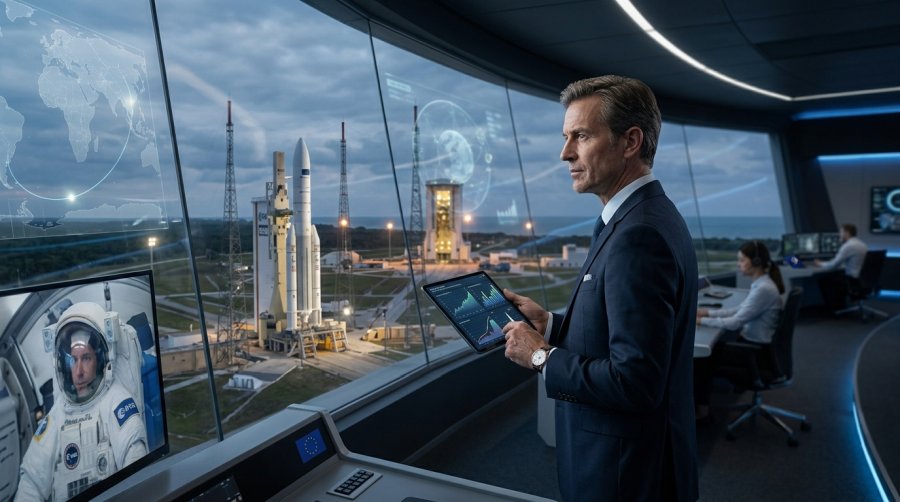
Europe is thinking big about space, and big money could follow. The global space industry is worth around €600 billion today. According to European Space Agency (ESA) director general Josef Aschbacher, it is expected to grow by about 10% a year. For anyone looking for long-term investment themes, that is hard to ignore.
Record budgets, wider mission
At its 2025 ministerial council, ESA received more than €22 billion in commitments from its member states. That is a record and 32% more than in 2022. Governments also gave the agency a new mandate to use space technology for non-aggressive security and defence, including monitoring Europe’s external borders. A bigger budget and a broader mission usually mean more contracts for industry.
The gap in Europe’s plans
Europe has no way to launch its own astronauts. Only the US, China and Russia can do it, and with political tensions around China and Russia, ESA depends on the US. In practice, European astronauts fly on American spacecraft built by SpaceX.
That is a risk. SpaceX has said it may retire Falcon 9 and Crew Dragon around 2029, so Europe could lose its current ride to space within a few years.
The €10 billion idea
Aschbacher’s answer is to build the capability in Europe. He estimates that about €10 billion over ten years could pay for a European crew vehicle and a recovery system to bring astronauts safely home. Europe is not starting from zero. It already runs Copernicus for Earth observation and Galileo for satellite navigation, and it has a skilled workforce.
Why spend instead of buy?
The alternative is not free. After the International Space Station is retired in 2032, it will likely be replaced by commercial stations. If Europe keeps buying seats on US spacecraft and renting lab space, Aschbacher estimates the cost at around €5 billion over ten years. In his words, that money would be spent outside Europe. He would rather invest it in European industry.
He also stressed that this is not about going it alone. Europe could even offer seats to partners such as Japan or Australia.
What it could mean for investors
A European crew programme would need spacecraft designers, engineering firms, component suppliers and companies working on ground systems and recovery. Companies in these areas could benefit if the project goes ahead. Dealing with international partners could create further opportunities. This is our reading of the situation, not a promise from ESA.
Keep the risks in mind
The plan still needs political approval and funding from ESA’s member states. Ten years is a long time, and budgets and priorities can change. The project is a proposal, not a done deal.
This article is for information only and is not investment advice.
Source:
Transparency Note: This article was prepared with the assistance of artificial intelligence technologies. Every piece is thoroughly reviewed and verified by our editorial team, who retain full responsibility for the final content.
Picture: Gemini AI