

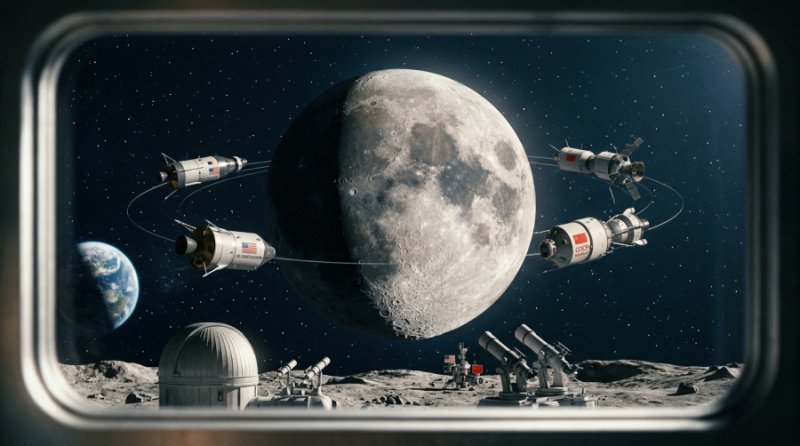
A Cold War treaty says nobody can own the moon. Yet governments and billionaires are racing to build bases and tap lunar resources, and the rulebook is surprisingly vague about what that is allowed to mean.
A promise made in the Cold War
In the 1960s, as the United States and the Soviet Union raced to the moon, there was a real fear that the winner would simply claim it. The Outer Space Treaty of 1967 was meant to prevent that. More than 100 countries agreed that the moon belongs to no one and that nations cannot claim space by occupying or using it. Exploration was supposed to benefit everybody. The treaty’s main focus was arms control, which is why it also bans nuclear weapons in orbit.
A new race, with billionaires on board
Nearly sixty years later, the picture looks different. The major powers are racing to build nuclear-powered lunar bases. Elon Musk talks about trillion-dollar markets, from lunar data centers to a launcher that could fling satellites deeper into space. Jeff Bezos imagines moving heavy industry off Earth so the planet can become a kind of garden. Meanwhile, the US government is eyeing helium and frozen water near the moon’s south pole, and China, together with Russia, wants to build its own base in the same region.
The gray area nobody wants to close
The treaty leaves big questions open. How much authority can a country claim over its base? Can a company profit from lunar wealth? Can anyone fence off an area and keep others out? An earlier attempt to settle such matters, the Moon Treaty of the late 1970s, treated lunar resources as the common heritage of humankind. Only 17 countries signed, and the US, the Soviet Union and China were not among them. According to space-policy scholar Bleddyn Bowen, nobody has had enough at stake to force a deal, since it remains unclear how much is up there and how to extract it cheaply. For now, he says, it is a gray area everyone is comfortable with.
Owning what you dig up
A popular legal argument holds that while no one can own the moon itself, states may own what they take from it. Its supporters point to the Law of the Sea, which allows deep-sea mining even though the deep sea is also a shared resource. The US passed a law in 2015 allowing companies to mine in space. The Artemis Accords, a nonbinding set of principles led by Washington and signed by 76 nations, say resource extraction does not violate the treaty. China and at least 12 other countries have struck a similar understanding for their joint lunar research station.
Keep-out zones and what comes next
The sharpest worry is about “safety zones.” NASA sped up its plan for a lunar nuclear reactor partly out of concern that China and Russia could build one first and declare nearby ground off-limits to American astronauts. Experts say even a safety-driven perimeter would clash with the treaty’s promise of free access. Some diplomats warn that letting the first arrivals set the rules could create de facto monopolies.
A United Nations working group is expected to finalize guiding principles by next year. But few countries have the money and technology to operate on the moon at all, so, as Bowen puts it, if China and America do everything there, they can largely settle the rules between themselves.
This article draws on “Who Owns the Moon?” by Selam Gebrekidan, published in The New York Times on October 4, 2026.
https://www.nytimes.com/2026/10/04/world/asia/who-owns-moon.html
Transparency Note: This article was prepared with the assistance of artificial intelligence technologies. Every piece is thoroughly reviewed and verified by our editorial team, who retain full responsibility for the final content.
Picture: Gemini AI