

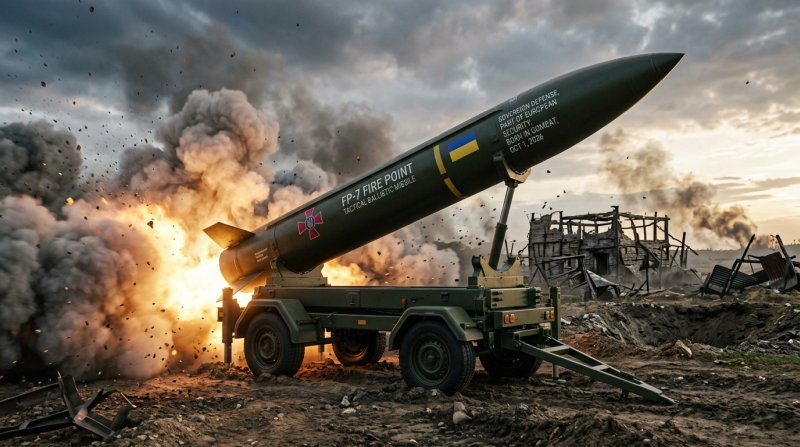
At the Helsinki Security Forum, defense firms showed how fast Europe is trying to close its capability gaps, from a Ukrainian ballistic missile that has just seen combat to sovereign satellite networks and locally built fighter-jet parts.
A private firm’s ballistic missile
Iryna Terekh, CEO of the Ukrainian company Fire Point, said its FP-7 missile was used in combat for the first time on October 1. It is a tactical ballistic missile with a maximum range of 300 kilometers, and a longer-range version is due later this year. She stressed that a private company built it in two years, a few times cheaper than competitors, thanks to less bureaucracy. The missile is meant to be part of the pan-European Freyja anti-ballistic defense program, with a prototype expected in the first half of 2027. For Ukraine, Terekh said, owning missiles “with no kill switch” means it no longer has to ask anyone’s permission to defend itself.
Hybrid threats at Europe’s doorstep
The forum was opened by Finnish President Alexander Stubb and Moldovan President Maia Sandu. Sandu said Russian drones have entered Moldovan airspace more than 45 times this year, and that Russia recently hit Ukrainian border crossings with Moldova, killing two people. Her answer is to invest in air defense and raise defense spending. Stubb described Russia’s approach in Europe as hybrid warfare: daily cyberattacks and sabotage attempts, such as the one seen in Leipzig, aimed at destabilizing allies and weakening support for Ukraine.
Sovereign satellites from Finland
On October 1, Finnish satellite operator Iceye and telecoms giant Nokia announced a partnership to build sovereign low-Earth-orbit communications for governments and military customers, with the first satellites planned for 2028. Iceye already supplies radar satellites to several European countries, and Germany’s December 2025 order for a 40-satellite constellation was the first large European tactical system of its kind, according to CEO Rafal Modrzewski. Nokia’s CEO Justin Hotard argued that sovereignty requires competitiveness, otherwise it becomes isolation.
F-35s with a European share
Finland formally received its first two of 64 ordered F-35 fighters on October 1. Lockheed Martin’s Elizabeth Parcella said the company is deepening cooperation with local industry: Patria has begun producing the forward fuselage, and about 25 percent of each F-35’s value will be made in Europe going forward.
Armored vehicles for the Arctic
Patria CEO Panu Routila pointed to a new contract to supply Trackx light armored vehicles to Finland and Sweden as a model of European cooperation. The tracked vehicle was developed in just three years for Arctic mobility. Deliveries start in 2027, followed by national and partly joint field trials.
This article draws on “Missiles, satellites and warplanes — Ukraine, Europe advance key arms projects” by Jaroslaw Adamowski, published on October 5, 2026, which reports from the Helsinki Security Forum.
Transparency Note: This article was prepared with the assistance of artificial intelligence technologies. Every piece is thoroughly reviewed and verified by our editorial team, who retain full responsibility for the final content.
Picture: Gemini AI