

Researchers make the case for simulation in dual-use technology assessment.
In a Q&A published on 29 September 2026, a known portal, Polytechnique Insights argues that
video games should be studied less for their visuals or market than for what their engines do: build controlled environments where action takes place.
The piece features philosopher of science and technology Vincent Bontems (CEA, Université Paris-Saclay) and applied mathematician Jean Langlois-Berthelot, formerly of École Polytechnique.
According to the authors, a game engine organises a space of actors, states, rules and feedback in which players can act, fail and try again.
A useful simulation is not the one closest to reality but the one that best serves a given problem, simplifying enough to stay manageable without making the lessons misleading.
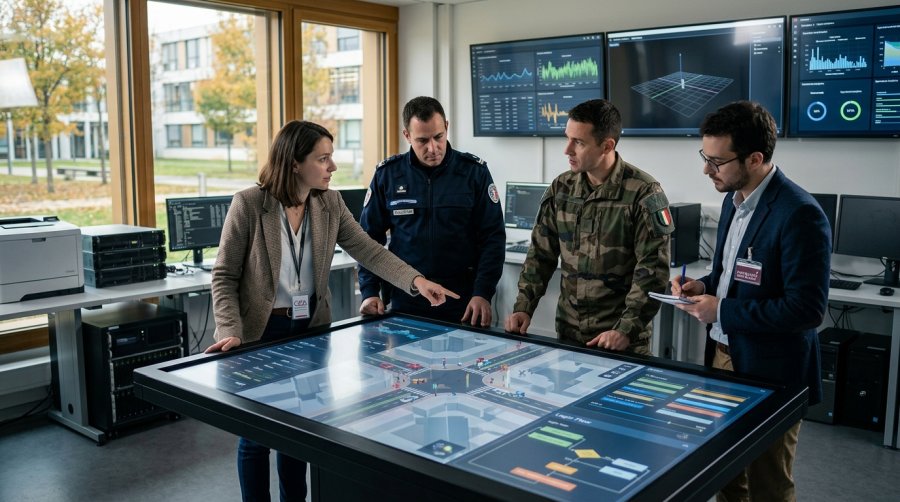
Two French projects illustrate the approach in practice: Signal Scope, built for the École Nationale Supérieure de la Police, and Operation Aconit, run for the French Army. Their aim is not to make training more fun but to create a framework for observation. Participants work with imperfect information and explicit constraints, and debriefings compare the paths taken, the dead ends and the workarounds. The real output is operational material showing how a group allocates attention, ranks risks and handles uncertainty.
The authors propose three axes for telling these systems apart: how realistic the entities’ behaviour is, how immersive the experience is, and how far a reward system engages emotions. In a project for the armed forces on wound management, they say, the goal was making the consequences of a wound manageable within an engaging experience rather than making it realistic for its own sake.
They also outline a six-step method, from identifying the real need and constraints to building a minimal environment, defining the thresholds to test, comparing scenarios and feeding the findings back to the organisation. Simulated worlds, they stress, should never be presented as predictions but as hypotheses that can be tested and contested.
The article also defends “multiversalism”, comparing alternative scenarios of the same problem, and science-fiction prototyping as serious methods. Bontems says they work when they strip away present-day certainties, amplify consequences and let dissenting views be voiced more easily inside hierarchies.
On dual-use technologies, the authors argue that civilian and military uses are now inseparable, citing robotisation, drones and AI. Maturity assessments, they say, must be complemented by attention to how these technologies shift the balance of power. They suggest asking what a solution does, what world of action it enables, and whether that world is technically, industrially and operationally sustainable.
Read the full interview at polytechnique-insights.com:
Transparency Note: This article was prepared with the assistance of artificial intelligence technologies. Every piece is thoroughly reviewed and verified by our editorial team, who retain full responsibility for the final content.
Picture: Gemini AI