

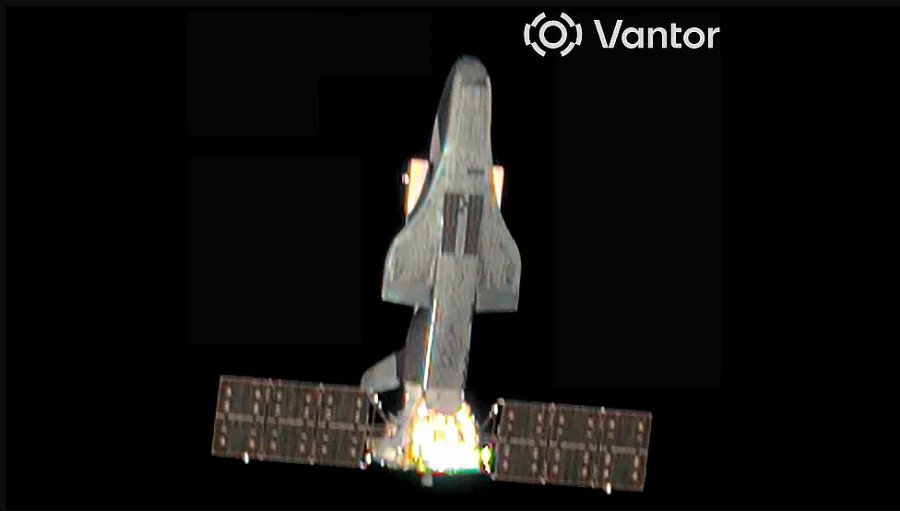
A newly released image shows the Shenlong spacecraft docked to another satellite, with its payload bay open
Few spacecraft are as mysterious as Shenlong, China’s reusable space plane, whose missions are announced in broad strokes and rarely explained. Now a US military intelligence agency has released a photograph that shows it in unusual clarity, and it raises as many questions as it answers.
A picture taken from 90 kilometres away
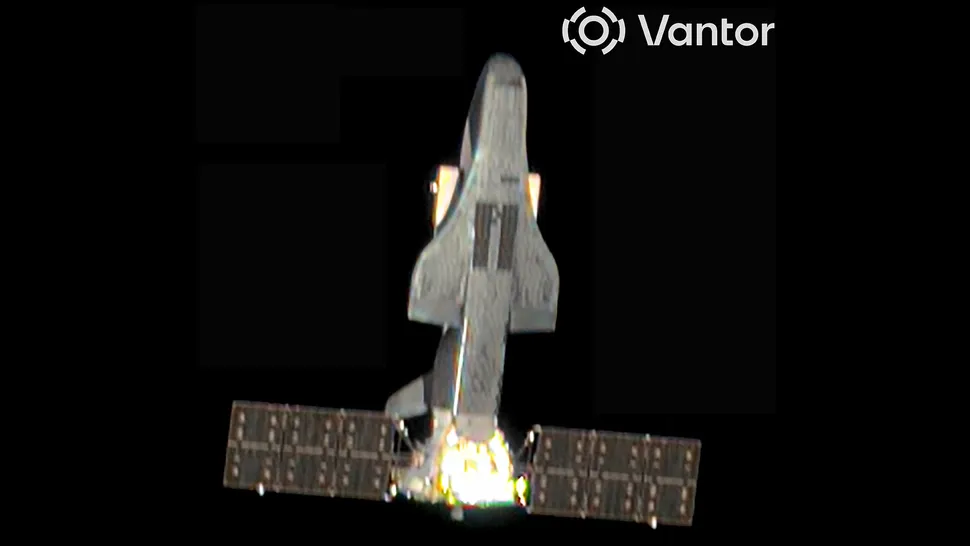
According to Space.com, the Defense Intelligence Agency (DIA) published the image in its latest space threat report. It was taken in 2024 by Vantor’s WorldView-3 commercial Earth-observation satellite from a distance of 56 miles (90 kilometres). The resolution is 4.5 centimetres per pixel, so each pixel covers less than the short edge of a credit card. Ground-based observers have photographed Shenlong before, but this is a view from space.
What the image shows
The robotic space plane appears docked to another satellite, one with its solar panels deployed. Which spacecraft that is remains unknown. Shenlong’s payload bay doors are open, which matters because a space plane with a bay is built to carry, deploy or work with objects in orbit, much as the cargo bay of the retired US Space Shuttle did.
Why a space plane is not just a satellite
A conventional satellite is launched, operated and abandoned. A space plane is reusable: it rides a rocket to orbit, stays for months, then re-enters and lands horizontally on a runway. Its wings and control systems give it flexibility in orbit, and its ability to come home allows engineers to inspect and refurbish hardware. Together with proximity operations such as docking, this makes the vehicle a flexible testbed for orbital manoeuvring.
A mission history of growing endurance
The DIA report traces the programme’s progress. The first mission, in 2020, lasted two days. The second, in August 2022, stayed up for 276 days and appeared to manoeuvre alongside a companion satellite at about 1 kilometre, at one point coming within roughly 100 metres. The third, launched in December 2023, lasted 268 days and also involved releasing and interacting with an object. The fourth mission launched in February 2026 and is still under study.
What China says, and what observers see
China’s space agency has said only that Shenlong tests technologies for cheaper, more convenient round trips to space for peaceful purposes. Outside observers have noted more complicated behaviour. In June 2026, the American space intelligence company LeoLabs reported detecting a new object near the space plane, which suggests another release in orbit.
Why it matters
Docking, releasing and retrieving objects are the building blocks of satellite servicing, but the same skills could be used for inspecting or interfering with other spacecraft. Because the same hardware can serve both purposes, the line between civilian and military use is hard to draw from the outside. That ambiguity is exactly why intelligence agencies are paying attention.
Photo: https://cdn.mos.cms.futurecdn.net/JpmpruDZZZWpvqmMs3f8F7-970-80.jpg.webp
Transparency Note: This article was prepared with the assistance of artificial intelligence technologies. Every piece is thoroughly reviewed and verified by our editorial team, who retain full responsibility for the final content.