

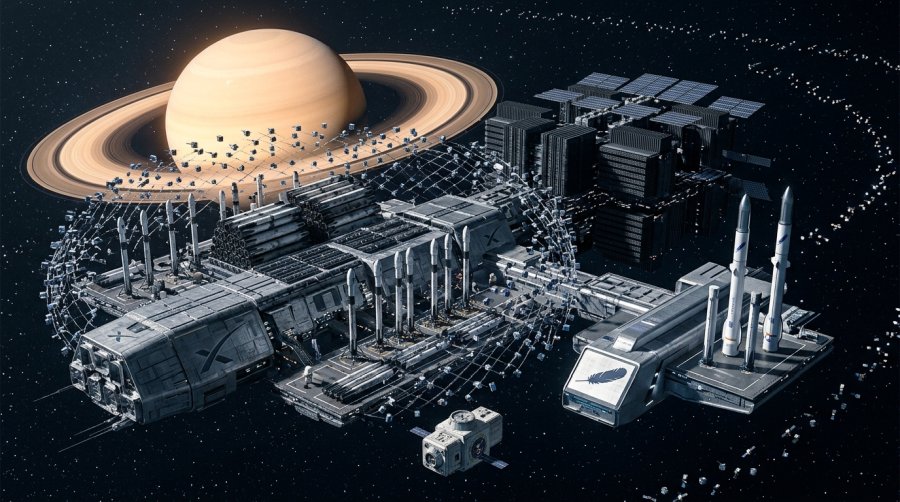
The contest for space is no longer fought mainly between states but between two billionaires and their companies, SpaceX and Blue Origin. In an NPR Fresh Air interview, The Atlantic’s Josh Tyrangiel says the rivalry is so strong that their only real competition is each other.
From a government race to a private one
Tyrangiel, a staff writer at The Atlantic, wrote the magazine’s November cover story, “Choose Your Overlord: Musk vs. Bezos”. He spoke to Terry Gross in an interview published on 15 October.
He traces the shift to a US policy decision in the early 2000s that opened space to commercial development, on the view that government was too slow and expensive. Even critics of Musk and Bezos, he says, believe that was the right call. But without governance, he argues, one or two well-capitalised individuals can take over a market.
SpaceX’s lead
According to Tyrangiel, SpaceX launched about 80% of the objects sent into orbit in 2025, and its closest competitor was the Chinese government, not Blue Origin. He notes that Blue Origin, founded in 2001, was described to him as more of a think tank or science experiment for its first decade. On reusability, he says he watched Blue Origin reuse a booster for the third time, then learned that SpaceX had reused its 600th.
He recalls Air Force sources calling the risk “the mercurial billionaire problem”. As an example, he cites the period when Musk, feuding with President Trump, threatened to stop producing the rocket that carries Americans to the International Space Station. The alternative, Tyrangiel says, would have been to pay about $80 million for a seat on a Russian rocket.
NASA’s limited reach
NASA still plays an important role in shaping US space policy, Tyrangiel says. Its administrator, Jared Isaacman, has set up a competition between SpaceX and Blue Origin for the Moon lander. Tyrangiel adds that NASA does not really oversee satellite activity, and that there are about 11,000 Starlink satellites in orbit.
Several people he spoke to suggested the government could assert more control by assigning roles: SpaceX to build the refuelling capability and Blue Origin the lander, which many of them considered superior. Isaacman did not speak to Tyrangiel for the piece.
Data centres in orbit
Tyrangiel says the SpaceX prospectus shows how much the future of space hinges on data centres, satellites and commercial business. People in the AI community, he reports, are eager for orbital data centres because of the shortage of power and the local opposition to building them on Earth. In space, he explains, solar energy is constant and cooling is easier. He calls the idea still theoretical and speculative. Google and a partner plan to launch two data-centre satellites, and Musk wants to have his up within a year.
Rules, satellites and open questions
Under international treaties, Tyrangiel notes, companies’ activity on the Moon is overseen by their home countries, so the United States is responsible for these firms. He says those mechanisms have not been used. Gross points out that SpaceX has asked the FCC to launch one million data-centre satellites. Tyrangiel doubts that number will be reached, and says nobody knows what so many objects would do to orbit. He also reports hearing that smaller satellite operators are losing access to SpaceX launches. He says no one at the Justice Department or the FCC appears to be looking at that as an antitrust issue.
Why two may be better than one
Tyrangiel relays a view from former national security adviser Jake Sullivan: a country benefits from one company that can do this, but “it’s better to have two.” In his words, the US may therefore need Blue Origin to succeed as quickly as possible.
Source: NPR Fresh Air, interview with Josh Tyrangiel, 15 October 2026
This article is for information purposes only and is strictly NOT an investment advice!
Transparency Note: This article was prepared with the assistance of artificial intelligence technologies. Every piece is thoroughly reviewed and verified by our editorial team, who retain full responsibility for the final content.
Picture: Gemini AI