

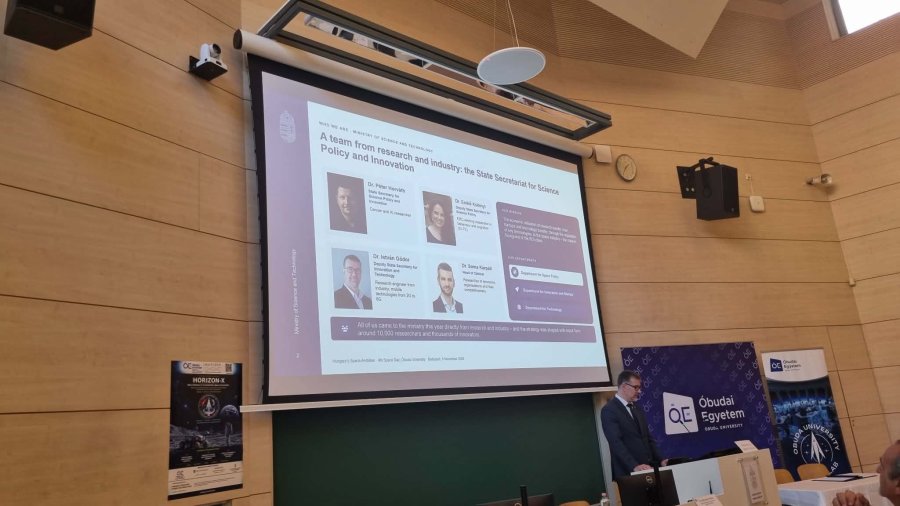
Opening of the 4th Space Day, Óbuda University, Budapest, 4 November 2026
Budapest, Hungary – at the opening of the 4th Space Day at Óbuda University, István Gódor, speaking for the Ministry of Culture and Innovation (TTM), set out the government’s priorities in science, innovation and space policy. His main themes were Hungary’s return to international research cooperation, the need to improve the country’s innovation performance, and the opportunities opening up for Hungarian space research.
Back in Horizon and Erasmus
Gódor welcomed that Hungary is fully back in the EU’s Horizon and Erasmus research programmes. The core restrictions were lifted as of this October, he said, and the ministry is already working to help Hungarian institutions make use of the reopened opportunities.
The urgency is clear from the European Innovation Scoreboard: Hungary ranks 21st among the 27 EU member states. With the EU average set at 100 percent, Hungary’s performance stands at 72.1 percent.
Five missions, with students at the centre
The government’s “Mission Hungary” strategy rests on five missions: environment, health, technology, social wellbeing and security. Gódor stressed that the most important task is reaching students, promoting an innovative mindset and supporting startups.
He described a continuous path running from ESA’s ESERO programme in schools, through the education system, to the space agency and the scale-up stage of young companies. Funding is backed by the National Research, Development and Innovation (NRDI) Fund, which he called a genuinely protected fund. Its budget is HUF 103 billion in 2026 and is set to grow to HUF 225 billion by 2029.
HUNOR: room for smaller teams
Gódor named the HUNOR programme as a flagship of Hungarian space activity. It includes 25 Hungarian experiments and activities on the International Space Station (ISS), with strong university and HUN-REN research groups taking part. Participation is not limited to teams working at technology readiness levels (TRL) 8–9, he noted, as smaller groups can also join. He added that Hungary now has its first space strategy since 2021.
In a personal aside, Gódor recalled that his father had worked on a radiation experiment in the era of Bertalan Farkas, Hungary’s first astronaut. Today, he said, Tibor Kapu, the country’s second astronaut, is the new hero.
Education, innovation agency and ESA
On education, Gódor said space-related studies are available at the highest level of engineering, at universities such as BME and Óbuda University, as well as in medical research.
He also said the National Innovation Agency needs to be made stronger, without elaborating further.
Finally, he said Hungary, which left the European Space Agency a couple of years ago, aims to return to ESA within roughly a year.
Transparency Note: This article was prepared with the assistance of artificial intelligence technologies. Every piece is thoroughly reviewed and verified by our editorial team, who retain full responsibility for the final content.
Photo: Insiderspace.eu – Istvan Gódor’s keynote speech at Obuda University