

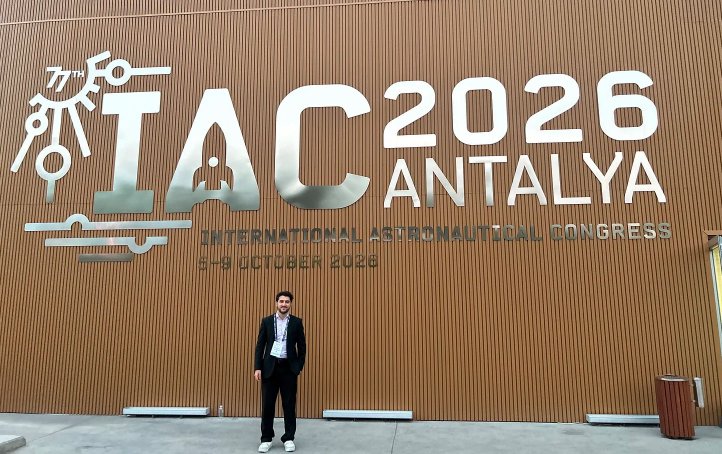
At this year’s International Astronautical Congress in Antalya, Türkiye, the talk was no longer about colonising Mars. It was about secure national satellites, the Moon, a crowded orbit and a shortage of rockets. Marat Airapetian, who attended, reports on it in the Space Ambition Substack (Issue 184).
The International Astronautical Congress, or IAC, is the largest annual gathering of the space world. In his report, Airapetian argues that its message this year was simple: space is turning into a normal industry. He is an observer with his own interests, since he works at a start-up in the field, and what follows is his reading of the week.
Ten years later, Mars has faded
At the 2016 congress, Elon Musk presented a giant rocket meant to carry the first colonists to Mars, only three weeks after one of his rockets had exploded on the launch pad, destroying an expensive satellite. The audience watched with a mix of awe and doubt. At that time, “private space” mostly meant SpaceX; everyone else was still raising small seed rounds.
In Antalya, Airapetian says, hardly anyone mentioned Mars. The exhibition hall was filled with mass-produced satellite platforms, and the head of Leonardo’s space division said there is no longer any such thing as “New Space”. Governments remain the main customers, but thousands of private firms now build businesses around them, from satellite images for farmers to telecoms. The money has not disappeared, the author says; investors have stopped paying for big dreams and started paying for practical and defence solutions.
Sovereignty has become a product
For the first time, military use of space was discussed openly, with speakers describing orbit as contested, not just crowded. For companies, this means governments are no longer buying prestige or science but control.
That helps explain why “sovereignty” became something to sell. The author points out that restrictions on Starlink in a war zone showed how risky it is to rely on a private network owned by someone else. At the congress, companies offered ready-made national satellite systems: ICEYE with Nokia, with European technology and first launches in 2028, and Open Cosmos, which raised €300 million partly for a secure satellite network. Luxembourg-based SES is also building a satellite factory for the EU’s IRIS² project.
A related new market is navigation. GPS and its European counterpart Galileo are free, but their signals are increasingly jammed or faked, including near conflict zones and around civil aviation. The start-up Xona raised $250 million to build satellites with a far stronger signal that can even be received indoors. A paid service that should not exist, the author says, appeared because the free one is no longer reliable.
One catch comes from analysts he quotes: buyers prefer suppliers from their own country or region, so the market is splitting into separate “islands” with fewer cross-border deals.
The Moon takes centre stage
The Artemis Accords, a set of principles for lunar exploration led by the United States, now have 76 signatories, and a NASA official said Russia and China could one day join if they accept the principles, though he stressed they do not today. NASA aims for a permanent base on the Moon before China gets there and a crewed landing in 2028, while China’s top priority is its own crewed landing.
According to the author, the question has shifted from why go to how to operate there: navigation, communications, power and resources. Panels discussed nuclear power on the Moon and safety zones around surface reactors, and the UAE expects mining of lunar resources to begin within a decade. A conflict that was named but not resolved: scientists see the lunar surface as heritage to protect, while companies see a potential warehouse of raw materials.
Too many satellites, too little cleanup
The final plenary session laid out the scale of the problem. By the end of the decade there may be about 50,000 satellites in orbit, and Starlink alone already makes around 35,000 collision-avoidance manoeuvres a year. An ESA expert noted that even if every operator follows today’s disposal rules, those rules still legally allow about a thousand dead satellites a year to be left in orbit.
Yet there is no paying market for cleaning up. The debris-removal company Astroscale said so openly, and customers are mostly space agencies and defence. In the absence of agreed international rules, the author argues, the biggest operator sets the standard: Starlink has the most to lose from a polluted orbit, so its own rules become the industry norm. Europe is taking a regulatory route, and a week after the congress ClearSpace won a £61 million UK contract to remove two dead satellites. The author predicts that devices that bring satellites down at the end of their life will become as standard as the power system.
A shortage of rockets
SpaceX has launched half of all mass sent to orbit in the past five years, and 80 per cent if its own Starlink satellites are counted. The author reports that SpaceX is winding down its Falcon 9 rocket and no longer takes bookings for after 2028, with NASA’s administrator saying the company plans to move to its larger Starship. For small satellite firms that planned around cheap shared launches, this means higher prices and longer waits. The result is a boom in alternatives, from Europe’s Isar Aerospace to South Korea’s Nuri, which put 15 satellites into orbit in a single launch during congress week.
Hype running ahead of the money
Two of the hottest topics, flying satellites very close to Earth, at 200 to 250 kilometres altitude, and building data centres in orbit, face the same obstacle. The companies involved say the technology is closer to ready than the funding. SpaceX has filed for up to a million data-centre satellites, yet people building such systems expect raising money to be the main constraint. Still, the author sees something real behind the talk, namely processing data from other satellites directly in orbit, and notes that data centres could drive in-orbit assembly of large structures.
A host with ambitions, and a regional link
Türkiye had no space agency a decade ago. It submitted 1,810 abstracts to this congress, more than any country in its history, says 87 per cent of its first lunar spacecraft’s equipment is domestic, and is building a spaceport in Somalia. For readers in Central and Eastern Europe, the next congress takes place in Poznań, Poland, a year from now, and the one after that in Samarkand, Uzbekistan, in 2028.
Airapetian’s conclusion is that the industry has grown up, with the downside that most of it still depends on governments as the main customer. The big open questions are who pays for a clean orbit, who writes the rules, and what will launch all of this if Falcon 9 is retired before Starship is ready.
Transparency Note: This article was prepared with the assistance of artificial intelligence technologies. Every piece is thoroughly reviewed and verified by our editorial team, who retain full responsibility for the final content.
Source & Picture: https://spaceambition.substack.com/p/iac-2026-takeaways-from-dream-to
Legal notice:
This article is general industry information and the author’s sector-level opinion. It does not constitute investment advice, investment research, or an investment recommendation within the meaning of Regulation (EU) No 596/2014 (MAR), and it contains no buy, hold or sell recommendation for any single financial instrument or issuer, nor any price or valuation estimate. The listing of named companies serves solely to illustrate the structure of the market. Past price data is no guarantee of future performance. Investing involves risk; the invested capital may be lost in whole or in part. Before making any decision, please seek the help of a licensed investment adviser.