

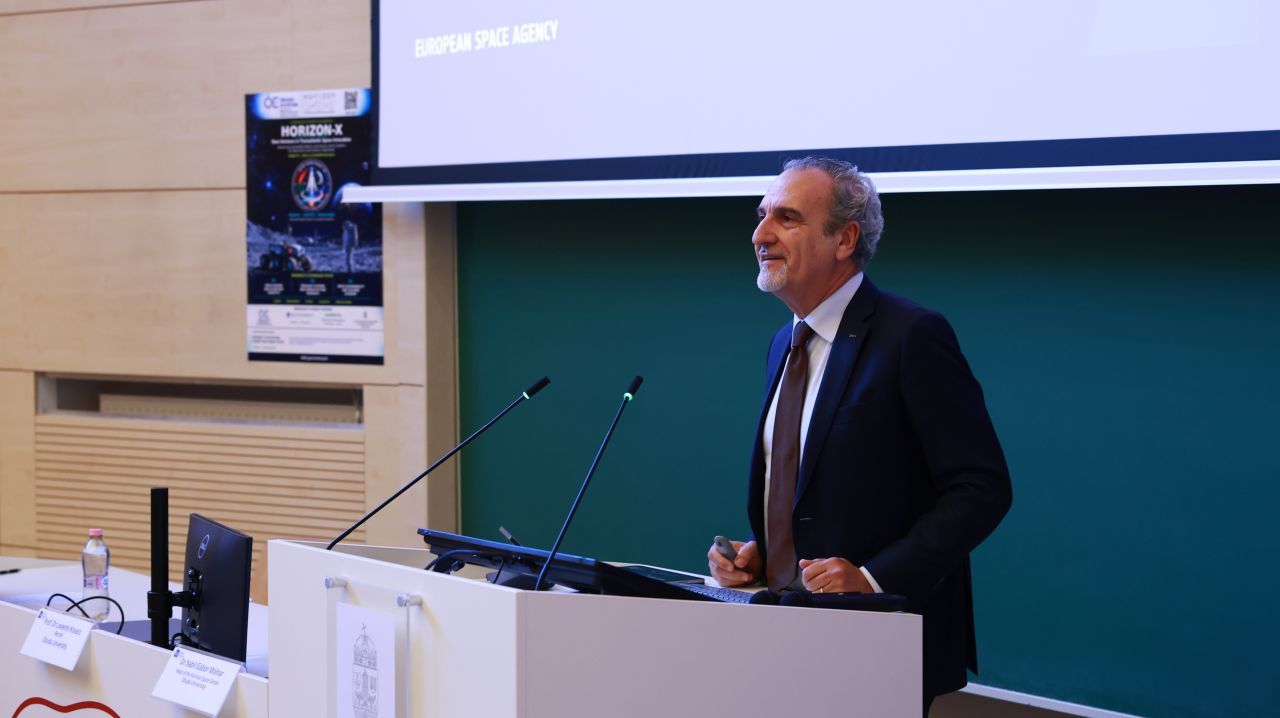
Space sustainability cannot be delivered by individual players alone, says Andrea Vena, Chief Climate and Sustainability Officer of the European Space Agency (ESA). In an exclusive interview fort Insiderspace.eu — on Annual Plenary Meeting of the Statement for a Responsible Space Sector at Óbuda University in Budapest, he explained how ESA wants to turn sustainability from a perceived cost into a competitive advantage, from de-risking new technologies and sustainable procurement to common methodologies for investors. He also spoke about how small developers can be supported and why a young space sector like Hungary’s may have an edge.
Why are community building and cross-border collaboration so vital for putting space sustainability principles into practice?
Because sustainability, and space sustainability in particular, cannot be achieved by individual actors alone. It requires collective action, shared responsibility and practical cooperation across the whole space community. The Statement was created to give the European space community a common foundation to act together, strengthening the sustainable development of the sector across the three environments it operates in: Earth, Earth’s orbit, and the Moon and deep space.
Updating Chapter 4 (Community Activities) of the Statement’s Ways of Working, its governance scheme, is therefore an opportunity to move from awareness and endorsement towards real implementation, with new, engaging activities on key emerging topics.
An active community, in my view, does five things:
- Turns principles into action: it translates high-level commitments into practical activities, guidelines and responsible operating practices.
- Builds a culture of responsibility: agencies, industry, academia and civil society come to see sustainability as a common obligation.
- Shares knowledge: it creates room to exchange technical expertise, lessons learned, research and best practices.
- Broadens participation: smaller players and new entrants get a meaningful voice.
- Maintains momentum: ongoing engagement, accountability and follow-up mean the Statement is not a one-time declaration.
How can Europe make sustainable space ventures more attractive to private capital, and which mechanisms or incentives would help most?
I can answer from ESA’s perspective and from what ESA is doing. We support this transition across the entire value chain, from technology development and ecodesign to procurement and policy support. By integrating sustainability into missions and procurement, we help create conditions in which companies investing in lower-impact technologies and processes see a clearer route to market uptake.
Public support can turn sustainability from a perceived cost into a competitive advantage. For that not to be wishful thinking, it takes three steps: de-risking solutions, sending the right signal, and making results measurable.
De-risking and first-mover support. Our RISE mission demonstrates rendezvous technology and closes a technology gap, with the aim of transferring it to a commercial player that can offer a life-extension service in geostationary orbit. For sustainability on Earth, we must finance not only the satellite but the full solution. Users also need data access, uptake support and integration into decisions in areas such as disaster response or agriculture. ESA’s Global Development Assistance (GDA) programme, for example, finances the end-to-end data pipeline and local training that turn data into actionable farming intelligence.
Sending the signal. Setting the standard through ecodesign policy and zero-debris requirements gives the market a clear picture of expected environmental performance. Sustainable procurement is moving towards additional sustainability criteria, which tells investors that more sustainable means more success in bids.
Making sustainability measurable and comparable. ESA has been developing a life-cycle assessment (LCA) methodology for space activities for more than a decade, and it now supports ecodesign across ESA missions. We have also built frameworks to assess sustainability benefits. Beyond our own missions, CNES and ESA have proposed a methodology for the EU taxonomy, with common environmental criteria for spacecraft and launchers. This gives companies and investors a clearer basis for deciding what can be considered sustainable.
How can ESA help small and mid-sized satellite developers meet climate goals without stifling innovation?
The objective is not to add another layer of burden for SMEs and mid-sized companies, but to give them the tools and technologies to innovate sustainably.
Through the European Space Sector Decarbonisation Roadmap, ESA can support common methodologies, better data and practical reduction levers. The approach must be proportionate: a CubeSat developer and a large industrial prime have very different capabilities, and the rules should reflect that.
When sustainability is built into spacecraft design early, it becomes a driver of innovation. It improves energy and resource efficiency, reduces dependence on critical materials and strengthens resilience. ESA supports this through technology development, including the Ecodesign Technical Roadmap and the activities of the ESA Green Agenda.
What role do you see for Hungary’s growing space ecosystem, including Óbuda University and programmes like HUNOR?
The Hungarian space sector is relatively young but growing fast, which is an ideal position from which to become a crucial actor in the European space sustainability roadmap. Sustainability has to be supported by innovation in technologies, products and industrial processes. A fast-growing ecosystem can exploit the opportunities linked to sustainability and establish itself as a key competitor in Europe.
This is easier than for a well-established sector with consolidated portfolios and industrial practices, which are much harder to change.
How can regional gatherings like this plenary help signatories turn ESA’s sustainability benchmarks into daily operations?
The real challenge is moving from commitment to implementation. Gatherings like the Budapest plenary let signatories learn from each other, share practical experience and, most importantly, understand industry needs and build Statement activities that benefit it. Those activities are also grounded in the latest sustainability topics for the space industry.
ESA contributes its expertise on topics such as ecodesign and LCA, Scope 3 emissions, sustainable supply chains and the space circular economy, as well as exchanges with experts on emerging challenges. All of this keeps the centrality of sustainability on Earth, in orbit and on the Moon and deep space in view.
Sustainable procurement is a good example. ESA’s ambition extends beyond emissions reduction. Through its purchasing power and convening role, ESA can build sustainability capabilities across the European space sector, stimulate more sustainable solutions and help suppliers anticipate evolving market and policy expectations. By anticipating these changes and avoiding duplicative requirements, ESA can support the longer-term competitiveness and resilience of the sector. We will work hand in hand with industry to accelerate action and collectively step up our efforts.