

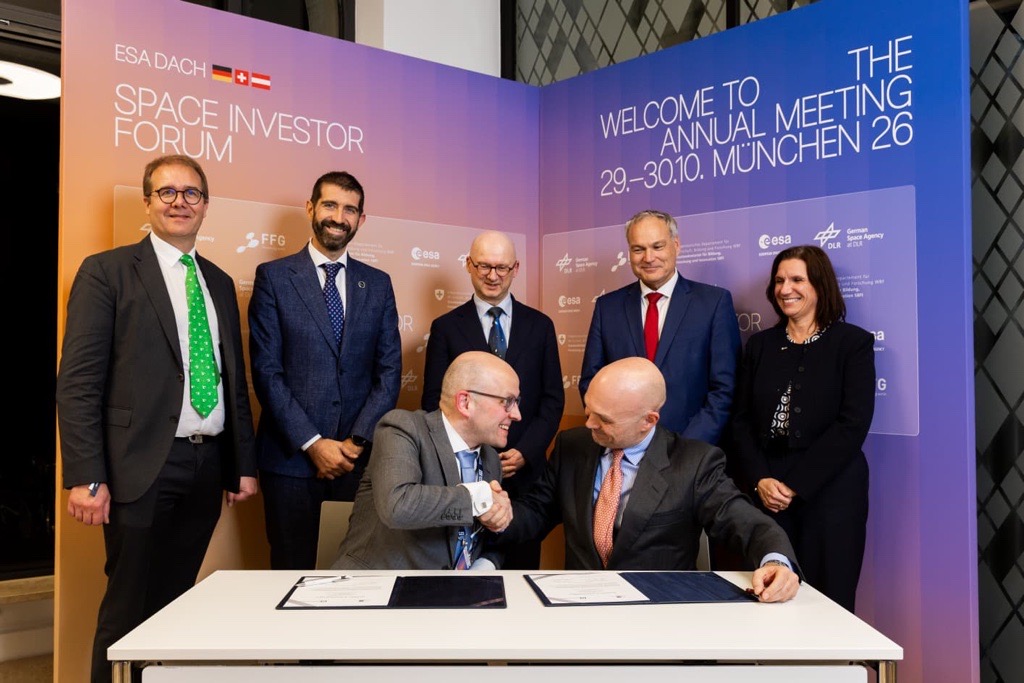
A new €560 million partnership between the European Investment Bank (EIB) and Deutsche Bank is set to widen access to long-term debt financing for European space companies, the European Space Agency reports. The agreement was announced on 29 October at the ESA DACH Space Investor Forum in Munich.
The announcement
The facility targets companies that have moved beyond technology development and are preparing for commercial growth and industrial scale-up. It is open to eligible firms across the EU, with a notable focus on Germany. Eligible activities span launch, satellite technologies, propulsion, Earth observation and in-orbit applications. The announcement drew senior representatives of Deutsche Bank, the EIB, ESA, the German Space Agency at DLR and the German federal ministry for research, technology and space.
Embedded in Space TechEU
The partnership forms part of Space TechEU, the EIB’s dedicated space financing programme, which is expected to mobilise around €1.4 billion in investment alongside commercial banks. The programme combines financing, guarantees and technical expertise, with the aim of giving banks the confidence to lend to a sector they often find difficult to assess. Deutsche Bank is the second partner after Intesa Sanpaolo, whose agreement is designed to facilitate lending to SMEs in Italy’s space supply chain. Both build on the EIB Space Lending Envelope announced at ESA’s Ministerial Council in 2025.
ESA’s role
ESA does not provide the loans itself. Its contribution is to bridge the space industry and the financial community, bringing its knowledge of the market, companies’ financing needs and existing barriers into the dialogue with banks. The agency’s Ventures and Financing Office has also developed the Space Debt Catalogue, which gives companies a clearer view of which financial institutions are active in debt financing, what solutions they offer and which types of firms they support.
The leadership view
ESA Director General Josef Aschbacher notes that Europe has a growing number of space companies with outstanding technologies ready to scale, and that securing the capital they need is the logical next step. Gianluigi Baldesi, Head of the Ventures and Financing Office, stresses the practical side: dialogue is only valuable if it yields clear routes to finance, suitable partners and solutions tailored to each stage of growth.
Why it matters
Space is a capital-intensive business. Production facilities, testing infrastructure and manufacturing capacity require sums that equity funding alone rarely covers, and debt can fill that gap. Public guarantees, in turn, lower the risk for commercial lenders and may make them more willing to engage with the sector.
The decisive questions are still open: how many companies will actually be reached, how quickly funds will flow, and whether smaller firms beyond Germany and Italy will benefit. Two bank agreements under a single programme, however, suggest a developing pattern rather than an isolated deal. If commercial banks come to treat space as a mainstream lending segment, European scale-ups could find the route to growth considerably more accessible.
Source: European Space Agency, “New EIB and Deutsche Bank partnership advances ESA’s push for greater access to finance for space businesses”, https://commercialisation.esa.int/new-eib-and-deutsche-bank-partnership-advances-esas-push-for-greater-access-to-finance-for-space-businesses/
Transparency Note: This article was prepared with the assistance of artificial intelligence technologies. Every piece is thoroughly reviewed and verified by our editorial team, who retain full responsibility for the final content.
Picture: EIB ESA partnership signing photo – https://commercialisation.esa.int/