

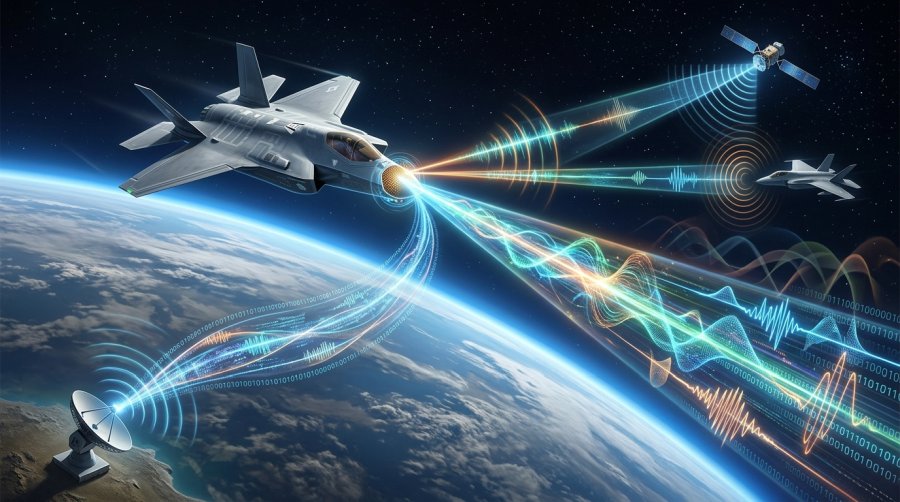
Modern defense and space platforms are running out of room — not physical room, but spectrum room. Every radar, every data link, every jammer and every satellite downlink wants its own slice of the radio spectrum, and that spectrum is finite. At the same time, every extra antenna, amplifier, and power supply adds weight, cost, and heat to a platform that may be flying, orbiting, or squeezed into a vehicle turret.
The industry’s answer to this squeeze is a technology called Integrated Sensing and Communication (ISAC): instead of running a separate radar system and a separate communications system side by side, ISAC lets a single RF front-end do both jobs with a single transmitted waveform. One signal goes out; part of its energy bounces off targets and comes back as radar returns, while the same signal also carries a data stream to a receiver. Think of it as a single flashlight beam that both illuminates the room and blinks out a message in Morse code.
The idea is elegant, but making it work well in the real world is anything but simple. A new piece of research tackles one of the toughest parts of that puzzle: how do you design a single waveform that senses accurately, communicates reliably, sips as little power as possible, and still survives contact with real amplifier hardware?
The Problem: Doing Two Jobs Without Breaking the Hardware
Any ISAC waveform has to satisfy three masters at once:
- Sensing performance — it needs to detect and resolve targets precisely, the same way a dedicated radar would.
- Communication quality — each user or receiver needs a signal strong and clean enough to decode reliably, usually expressed as a minimum Signal-to-Interference-plus-Noise Ratio (SINR).
- Hardware reality — the waveform has to be efficient to transmit.
That third point is where a lot of ISAC research quietly runs aground. RF power amplifiers — the components that actually push the signal out of the antenna — work most efficiently when the signal’s power stays close to a steady, predictable level. If a waveform has sudden, extreme spikes in power (even briefly), the amplifier has to be built with a lot of extra headroom just to avoid distorting those peaks. That headroom is wasted efficiency: more heat, more wasted energy, and a bulkier, more expensive amplifier for the same average output. Engineers measure this spikiness with a number called the Peak-to-Average Power Ratio (PAPR) — literally, how much higher the tallest peak is compared to the average power level. A “peaky” waveform has a high PAPR and is hard on hardware; a “smooth” waveform has a low PAPR and is efficient and forgiving.
So the real engineering challenge isn’t just “design a waveform that senses and communicates well” — it’s “design one that does both while staying power-efficient and gentle on the amplifier.” That combination turns out to be mathematically brutal, which is exactly what this research set out to solve.
A Better Ruler: Introducing AF-SINR
To design a good sensing waveform, you first need a good way to measure how good it is. Traditional radar theory already has a tool for this called the ambiguity function — essentially a map showing how sharply a waveform can pin down a target’s range (delay) and speed (Doppler shift). A perfect radar waveform would produce a map with one tall, narrow spike exactly where the real target is, and nothing but flat ground everywhere else. In practice, every real waveform produces a central spike (the mainlobe) plus a scattering of smaller, unwanted bumps elsewhere on the map (sidelobes). Those sidelobes are a problem: they can be mistaken for targets that aren’t really there, or they can mask a real, weaker target sitting nearby in range or speed.
The researchers introduce a new way to score this trade-off, called AF-SINR — Ambiguity-Domain Sensing Signal-to-Interference-plus-Noise Ratio. Rather than just asking “how much total energy is in the signal,” AF-SINR zooms into the specific delay-Doppler region where a target of interest is expected to be, and asks a sharper question: how much taller is the useful mainlobe spike compared to the leftover sidelobe clutter and background noise right around it?
This matters for two reasons:
- It’s localized, not global. A waveform can look excellent on average across the whole ambiguity map while still being sloppy in the one region that actually matters — say, the range and speed window where an adversary’s aircraft or missile is expected to be. AF-SINR grades the waveform specifically on the region of interest, not on a system-wide average that can hide local weaknesses.
- It’s noise-aware. Real radar receivers don’t operate in a vacuum — there’s always thermal noise and self-interference in the system. AF-SINR bakes that reality into the score, so a waveform optimized against this metric is being judged the way a real receiver would actually experience it, not against an idealized, noise-free textbook case.
In short, AF-SINR is a more honest, more targeted scorecard for sensing quality — one built for the messy conditions of an actual operational system rather than a clean simulation.
Setting the Rules of the Game
With a way to measure sensing quality in hand, the researchers framed the waveform design as an optimization problem with a clear goal and a set of hard constraints:
- Objective: minimize the total transmitted power — because every watt not spent is a watt saved on generator load, battery life, thermal management, or (on a spacecraft) solar panel and battery sizing.
- Communication guarantee: every communication user must still receive a signal that clears a minimum required SINR, so squeezing power doesn’t come at the cost of dropped links or garbled data.
- Hardware guarantee: the waveform must respect a strict PAPR ceiling, so it plays nicely with real, efficient amplifier hardware rather than requiring an oversized, wasteful one.
Framed this way, the task becomes: find the lowest-power waveform that still hits its communication targets, still keeps sensing sharp and unambiguous in the region that matters (as measured by AF-SINR), and still stays within the amplifier’s comfort zone.
Why This Is Mathematically Nasty
If this sounds like a lot of competing demands pulling in different directions, that’s because it is. In optimization terms, the problem is nonconvex — which, without the jargon, means there’s no simple, guaranteed path to the best answer. Three separate features of the problem each make it harder:
- The communication SINR requirement is a fractional expression (a ratio of signal to interference-plus-noise), and ratios are notoriously awkward to optimize directly.
- The AF-SINR sensing metric involves quartic (fourth-power) terms in the waveform — the ambiguity function comes from correlating the signal with a shifted, delayed copy of itself, which multiplies complexity fast.
- The PAPR constraint adds its own tangled, non-smooth dependency on the exact shape of the waveform.
Stack all three together and you get a problem that can’t be solved by simply turning a mathematical crank — you need a smarter strategy.
The Solution: FP-SCA — Breaking a Hard Problem Into Easy Pieces
The paper’s answer is an algorithm called FP-SCA, short for Fractional-Programming Successive-Convex-Approximation. The name is dense, but the idea behind it is intuitive: when a problem is too tangled to solve in one shot, approximate it, over and over, with a series of simpler problems that each can be solved reliably — and let each solution guide the next approximation, edging closer to the real answer with every round.
- Fractional programming is a set of mathematical tricks for taming those awkward ratio expressions (like the communication SINR requirement), turning them into a form that’s easier to handle.
- Successive Convex Approximation (SCA) is the “divide and conquer” part: at each step, the algorithm replaces the full nonconvex problem with a convex stand-in — a simplified version that’s mathematically guaranteed to have a well-defined, reliably solvable best answer. It solves that easier version, uses the result to build an improved (and still convex) approximation for the next round, and repeats. Each cycle nudges the waveform closer to a solution that genuinely satisfies all the original power, communication, sensing, and PAPR requirements.
The upshot is that FP-SCA takes a problem that has no straightforward solution method and turns it into a sequence of well-behaved sub-problems, each solvable with standard, efficient optimization tools.
What the Simulations Showed
Testing the approach numerically, the researchers found that the FP-SCA-designed waveforms delivered on all fronts at once: transmit power was driven down toward the minimum needed, every communication user’s SINR requirement was still met, and the sensing performance — measured through AF-SINR — showed clearly suppressed sidelobe leakage in the delay-Doppler region that mattered. In other words, the algorithm didn’t just trade one goal off against another; it found waveforms that were simultaneously power-lean, communication-reliable, and sensing-sharp, all while staying inside the PAPR limits that real amplifiers require.
Why It Matters for Defense and Space Systems
For platforms where size, weight, power, and spectrum are all under constant pressure — a fighter’s AESA array doing both fire-control radar and a covert data link, a naval combat system multiplexing surveillance and networking on one aperture, or a satellite that needs to both track objects and downlink telemetry without doubling its RF payload — this kind of result is more than academic. A waveform that cuts transmit power without sacrificing detection sharpness or link reliability translates directly into longer endurance, smaller thermal footprints, lighter payloads, and a lower, less detectable RF signature. And because the design explicitly respects amplifier hardware limits, it’s not just a theoretical best case — it’s built with an eye toward what can actually be fielded.
ISAC is often described as the next logical step for congested-spectrum, multi-mission platforms. Work like this — building sharper metrics like AF-SINR and practical algorithms like FP-SCA to actually hit real-world power and hardware targets — is what turns that vision from a slide-deck concept into an engineering blueprint.
Original Source:
https://arxiv.org/abs/2609.05390v1
Transparency Note: This article was prepared with the assistance of artificial intelligence technologies. Every piece is thoroughly reviewed and verified by our editorial team, who retain full responsibility for the final content.
Picture: Gemini AI