

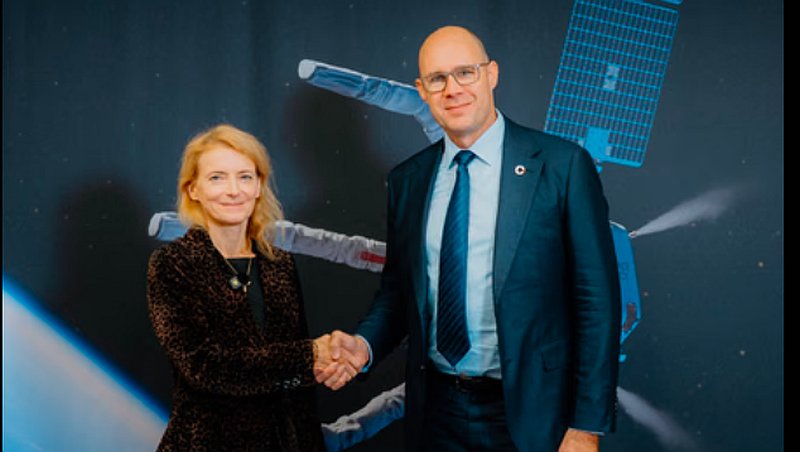
Space is getting crowded, and cleaning it up is becoming a real business. On 15 October, Luxembourg-based ClearSpace announced that its UK subsidiary had won a contract worth about £61 million, or $80 million. The job is to remove two dead satellites from orbit around Earth. For investors watching the space economy, it is a deal worth a closer look.
What the mission involves
The UK is paying for a mission planned for 2029. A service spacecraft will fly to two UK-licensed satellites that no longer work, both in low Earth orbit. The tricky part is that these satellites were never designed to be caught by another spacecraft, so the approach and manoeuvring will be demanding.
Once close enough, the ClearSpace vehicle will match the targets’ movement and grab each satellite with four robotic arms. It will then guide them onto a planned path that ends with a burn-up in the atmosphere. The launch window closes on 30 August 2029.
A competitive win
ClearSpace beat two strong rivals for the contract: Astroscale from Japan and Starfish Space from the US. The money covers the final phase of a UK programme that has been in preparation for more than five years. It should carry ClearSpace through the critical design review and prepare the ground for integration, qualification and the mission itself.
More work in the pipeline
The company is not relying on one project. Its Swiss unit is working on removing ESA’s Proba-1 satellite, in a mission led by OHB and planned for 2029. A programme called Prelude will test close-proximity operations with two small satellites in 2027. ClearSpace is also preparing Phoenix, a mission to extend the life of a geostationary satellite that is due to retire between 2028 and 2030.
The UK wants a leading role
In its space strategy, published in September, the British government named in-space servicing, assembly and manufacturing as a priority. This area is known as ISAM. It covers not only removing junk but also repairing satellites, refuelling them and extending their working lives. The UK space minister, Liz Lloyd, said debris is a growing challenge and the country wants to use its own expertise to help solve it.
Rivals are still moving
Astroscale has not stopped. Its ELSA-M mission could launch between 1 May 2027 and 30 April 2028 on a rocket from Germany’s Isar Aerospace. The service vehicle is designed to handle several satellites fitted with magnetic docking plates, but for now its target is a single OneWeb broadband satellite.
What it means for investors
Governments are starting to pay for orbital clean-up, and the market for servicing satellites looks set to grow around it. Companies in robotics, navigation, spacecraft building and launch services could all benefit. Even so, these missions are new and technically hard, and the first real results are still years away. This is our reading of the situation, not a forecast.
This article is for information only and is not investment advice.
Sources:
https://clearspace.today/news/clearspace-prime-uk-active-debris-removal-contract
Spacejunkie.hu
Transparency Note: This article was prepared with the assistance of artificial intelligence technologies. Every piece is thoroughly reviewed and verified by our editorial team, who retain full responsibility for the final content.
Picture: Gemini AI