

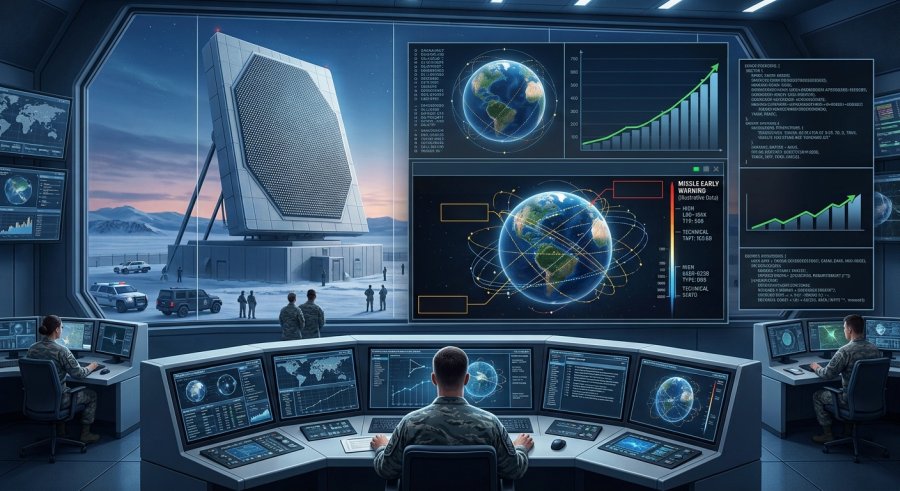
Space is not only about rockets and satellites. It also depends on the ground systems that watch the sky. On 15 October 2026, Raytheon, a business of RTX (NYSE: RTX), announced that it had been selected to modernize U.S. Space Force radar sites. For investors following space and defence, the news shows where government money is heading.
What these radars do
The radar sites form the outermost layer of the United States’ missile-defence system. They give early warning of launches, identify and describe objects in space, and track activity there. In simple terms, they are the country’s long-range eyes on the sky.
The programme behind the deal
The work falls under the Ground-Based Radar Digitization (GBRD) programme. Raytheon will work with the Space Force to upgrade long-serving systems, with the goal of better performance, higher reliability and more advanced capabilities. The company says the upgrades should keep the radars useful for decades. The announcement did not include a contract value or a timeline, so investors should keep that in mind.
How the upgrade will work
Raytheon describes its approach as a proven, mature solution built on rapid development. It creates a shared technical foundation for the whole GBRD portfolio, so new capabilities can be delivered faster. The programme will first deliver prototype solutions, then move to rapid fielding at the remaining locations.
An open design
One detail stands out. Raytheon, the Space Force and industry partners will build a common open architecture. According to the company, this makes it cheaper to maintain the systems, avoids dependence on a single vendor and makes later upgrades simpler. For the wider industry, an open design could leave room for other suppliers to join in. That is our interpretation, not something the announcement promises.
Why the timing matters
Sam Deneke, president of Air & Space Defense Systems at Raytheon, said that digitizing the radars is essential to stay ahead of increasingly complex global threats. The upgrade also fits a wider trend. Governments are putting more weight on awareness of what happens in space and on layered, more resilient security systems.
Who is behind the winner
Raytheon has more than a century of experience in air and missile defence, advanced sensors and radars, interceptors, space-based systems and hypersonics. Its parent RTX has more than 180,000 employees and reported 2025 sales of over $88 billion. This is a large, established player rather than a young start-up.
What it could mean for investors
The deal points to steady demand for upgrading existing space and defence infrastructure, not just building new hardware. Companies working in radar electronics, software, data processing and systems integration may find opportunities in this field. The focus on open architecture could also help smaller suppliers get a place in future projects. Established defence contractors like RTX are the most direct beneficiaries, but one announcement does not say how much revenue it will bring.
Keep the risks in mind
The release gives no financial details, and the programme is still at an early stage, starting with prototypes. Defence budgets depend on politics and can shift. Delays are also common in large government projects. Investors should wait for concrete figures before drawing conclusions.
This article is for information only and is not investment advice.
Source: RTX / Raytheon press release
Transparency Note: This article was prepared with the assistance of artificial intelligence technologies. Every piece is thoroughly reviewed and verified by our editorial team, who retain full responsibility for the final content.
Picture: Gemini AI