

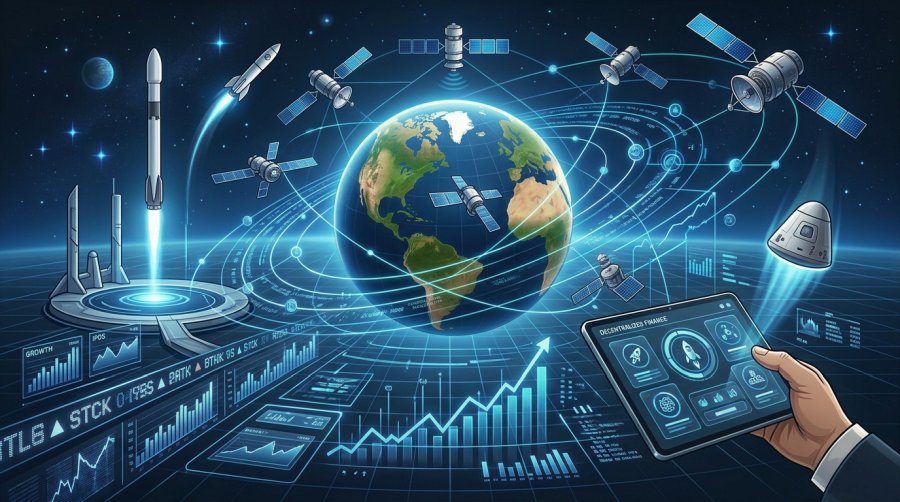
Space investments – expert opinoin by Áron Boros, CEO, Stradamus Zrt.
– Important notice – this article is an opinion piece, not investment advice! –
First and foremost: this article presents the personal views and observations of Áron Boros, CEO of Stradamus Zrt., on the space industry as a whole. It is a sector-level overview. It does not provide investment advice on any specific share or issuer, contains no buy, hold or sell recommendation, and expresses no view on the value or prospects of any individual company. Please also see the full disclosures at the end of the article.
SpaceX listed on the Nasdaq on 12 June 2026, raising $75 billion in the largest initial public offering in history. As a result, the industry’s defining player is now within reach of anyone who has a brokerage account.
The question I have been asked most often since then is: how can a private individual with a smaller sum take part in this sector? This article offers a framework for answering it: which sub-segments are worth watching, what return and risk profile comes with each, and what routes into the sector are available with a budget of up to roughly €10,000.
The short answer is that several dozen space companies and suppliers now trade on regulated exchanges, and a significant share of them can also be found in retail investment apps.
Why now?
According to a 2024 study by the World Economic Forum and McKinsey, the global space economy could grow from $630 billion in 2023 to $1.8 trillion by 2035. That is annual growth of roughly 9%, nearly twice the expected pace of the global economy. The same study puts the range between its pessimistic and optimistic scenarios at $1.4 trillion to $2.3 trillion.
Three trends are driving this growth:
- Plummeting launch costs. Reusable rockets make it cheaper to put a payload into orbit, which makes new business models viable.
- Government and defense demand. Both the United States and Europe are increasing their space defense spending, which gives part of the sector a predictable order backlog.
- Capital market momentum. In 2025–2026, space companies came to the stock market one after another (Voyager, Firefly, York Space Systems, SpaceX), so the sector is no longer accessible only through venture capital funds.
In my personal view, over a ten-year horizon the space industry is one of the most interesting growth areas.
Note: this is a conviction about the sector as a whole, not an expectation about the shares of any individual company.
Four segments worth watching
1. Launch and space transportation
This is the sector’s infrastructure: every other business model depends on how much it costs, and how often it is possible, to reach orbit. The market is highly concentrated, with only a few players operating a proven, regularly flying launch vehicle. Barriers to entry are high, development cycles are long and capital-intensive, and a single failed launch can set a program back by months.
2. Satellite communications and Earth observation
This is where the largest share of the space industry’s commercial revenue is generated today: broadband internet, direct-to-device mobile connectivity, imaging and data analytics. The segment is more mature, and many of its companies have recurring subscription or government-contract revenue. The key risk is capacity competition: large constellations put pricing pressure on traditional operators.
3. Space stations and in-orbit infrastructure
The International Space Station is scheduled to be retired around 2030, and commercial players are competing to succeed it. This segment also includes in-space manufacturing, satellite servicing and lunar logistics. Much of it is still at the pre-revenue stage and depends heavily on orders from NASA and other space agencies. Most of the players are private companies.
4. Orbital computing and AI infrastructure
This is the youngest segment. Given the energy and cooling demands of terrestrial data centers, several companies are examining whether part of the computing capacity could be deployed in orbit. The first experimental hardware is already operating, but the economics are unproven: according to industry calculations, orbital computing is still several times more expensive than computing on Earth, and analysts place commercial-scale operation after 2028–2030. On the stock market, this segment typically appears only indirectly, through suppliers of chips, optical components and materials technology.
Return expectations and risks
Industry growth and shareholder returns are two different things. The annual market expansion of around 9% is an estimate of sector revenues; the fact that a market is growing does not mean that the shareholders of the companies listed at any given moment will earn the same.
Based on the history of young, capital-intensive industries, it is worth expecting three things:
- Widely dispersed outcomes. Typically, a handful of winners generate most of the sector’s value creation, while a significant share of companies underperform or disappear.
- Large swings. York Space Systems listed in January 2026 at an offer price of $34, traded below $19 in July, and hit a 12-month low of $7.45. Voyager Technologies closed more than 80% above its offer price on its first trading day in June 2025. These are facts, not forecasts; they show how large the moves can be within a few months.
- A long runway. Most companies are loss-making and payback comes years after the investment, while further capital raises may dilute shareholders in the meantime.
The main risks:
| Risk | What it means in practice |
| Technological | Failed launches or missions, slipping development schedules |
| Financing | Loss-making operations, repeated capital raises and dilution |
| Customer concentration | Dependence on the budget decisions of a few government customers (NASA, defense ministries) |
| Valuation | A large part of expectations may already be priced in |
| Regulatory and geopolitical | Export restrictions, spectrum and orbital licenses, space-debris regulation |
| Currency | Most companies are quoted in US dollars, so a forint- or euro-based investor also bears exchange-rate risk |
Anyone investing in this sector must be prepared to lose a significant part of their capital and, in the extreme case, all of it.
What can you do with €10,000?
€10,000 is not a target but an upper limit for someone who is just getting acquainted with the sector. The logic is simple: it should be an amount whose loss would be unpleasant but would not change your life.
Here are some general principles that both the literature and practice support for high-risk, thematic exposure:
- Only money you can spare. Money that you may need within ten years for a home, a reserve fund or retirement does not belong here.
- A small share of total savings. A thematic sector is a complement to a portfolio, not its foundation.
- Diversification instead of a single bet. Since it cannot be known in advance which company will win, exposure is best spread across several players and several segments. For those who do not want to pick individual companies, exchange-traded thematic funds (ETFs) also exist.
- Staged entry. Buying in installments reduces the risk of entering right at a peak.
- A ten-year mindset. Anyone who would sell during a 50% drawdown is probably not suited to this sector.
Which of these suits a given person’s situation depends on individual circumstances. A licensed investment adviser can provide personalized help with that.
Market map: who is listed?
The list below shows which space companies and suppliers have shares trading on regulated markets in October 2026. The subject of this article is the four segments; the companies appear as examples of players within them. The list is not a selection, not a ranking and not exhaustive. Inclusion does not imply a view on any company’s value or prospects.
| Segment | Company | Exchange: Ticker | Main activity | Lightyear | Revolut |
| Launch | SpaceX | Nasdaq: SPCX | Launch vehicles, Starlink satellite internet | Yes | In app |
| Launch | Rocket Lab | Nasdaq: RKLB | Small and medium launch vehicles, satellite manufacturing | Yes | In app |
| Launch | Firefly Aerospace | Nasdaq: FLY | Launch vehicles, lunar landers | Yes | In app |
| Launch | Avio | Borsa Italiana: AVIO | Vega launch vehicles, propulsion | No – broker only | In app |
| Satellite services | AST SpaceMobile | Nasdaq: ASTS | Direct satellite-to-mobile-phone connectivity | Yes | In app |
| Satellite services | Iridium | Nasdaq: IRDM | Global satellite communications | Yes | In app |
| Satellite services | Viasat | Nasdaq: VSAT | Satellite broadband | Yes | In app |
| Satellite services | Eutelsat | Euronext Paris: ETL | Satellite operations, OneWeb constellation | Yes | In app |
| Satellite services | SES | Euronext Paris: SESG | Satellite operations | Not found; broker only | In app |
| Earth observation | Planet Labs | NYSE: PL | Daily Earth observation imagery | Yes | In app |
| Earth observation | BlackSky | NYSE: BKSY | Imaging and analytics | Yes | In app |
| Infrastructure | Voyager Technologies | NYSE: VOYG | Defense and space technology, Starlab space station | Yes | In app |
| Infrastructure | Redwire | NYSE: RDW | In-space manufacturing, structural components | Yes | In app |
| Infrastructure | Intuitive Machines | Nasdaq: LUNR | Lunar delivery and communications | Yes | In app |
| Infrastructure | York Space Systems | NYSE: YSS | Satellite platforms for defense customers | Yes | In app |
| Infrastructure | MDA Space | Toronto: MDA | Robotics, satellite systems | No – broker only | No – broker only |
| Infrastructure | OHB | Xetra: OHB | Satellite manufacturing, European programs | Yes | In app |
| Suppliers | Karman | NYSE: KRMN | Propulsion and structural subsystems | Yes | In app |
| Suppliers | Airbus | Euronext Paris: AIR | Satellites, Ariane stake | Yes | In app |
| Suppliers | Thales | Euronext Paris: HO | Satellite manufacturing (Thales Alenia Space) | Yes | In app |
| Suppliers | Leonardo | Borsa Italiana: LDO | Space electronics, satellite services | No – broker only | In app |
| Suppliers | Northrop Grumman | NYSE: NOC | Propulsion, satellite servicing | Yes | In app |
| Suppliers | L3Harris | NYSE: LHX | Propulsion, sensors | Yes | In app |
| Japan | ispace | Tokyo: 9348 | Lunar landers | No – broker only | No – broker only |
| Japan | Astroscale | Tokyo: 186A | Space-debris removal, satellite servicing | No – broker only | No – broker only |
| Japan | Synspective | Tokyo: 290A | Radar-based Earth observation | No – broker only | No – broker only |
| Japan | iQPS | Tokyo: 5595 | Radar-based Earth observation | No – broker only | No – broker only |
Availability is based on the providers’ public offerings as of 7 October 2026 and may change. “Broker only” means that the share is available through a full-service investment provider with access to the relevant exchange (for example, a domestic bank or online broker offering international markets).
For suppliers and large defense companies, space accounts for only part of total revenue. Pure-play space companies are smaller and typically more volatile.
The space-station builders (Vast, Axiom Space) and the pioneers of orbital computing infrastructure (for example, Starcloud) are private companies at the time of writing and are not available on the stock exchange.
Access and costs
Shares of companies listed on the New York exchanges are typically available in retail investment apps operating in Hungary as well. The fees of the two best-known examples, as stated by the providers themselves:
| Lightyear | Revolut | |
| US share order fee | 0.1%, minimum USD 0.10, maximum USD 1 | Monthly fee-free allowance depending on plan (Standard: 1 order), then 0.25%, minimum HUF 368 |
| Euro-denominated shares | EUR 1 per order | As above |
| Currency conversion | 0.35% | Depends on plan and time |
| Offering | More than 4,000 US stocks, plus European and UK markets | More than 3,000 US and European stocks |
| TBSZ (Hungarian tax-advantaged long-term investment account) | Available, free of charge | Not available |
A worked example: EUR 10,000 spread across ten US shares (based on Lightyear’s fee schedule) comes to roughly EUR 35 in currency conversion costs and EUR 9 in order fees, or about 0.45% of the amount invested. Cost, in other words, is not the obstacle; risk is what matters.
Three practical notes:
- Offerings differ by platform and change over time. Companies listed in Tokyo and Toronto are typically not available in retail apps; for European shares, it is worth checking each one individually.
- Taxation. For a private individual who is a Hungarian tax resident, the TBSZ allows tax-free returns after a five-year lock-in; of the two examples, a TBSZ can only be opened with Lightyear. On a standard account held with a foreign provider, the investor typically has to declare the gains themselves. Involving a tax adviser is advisable for the details.
- Investor protection. The two providers operate under foreign supervision (Estonian and Lithuanian, respectively), and their investor-protection limits differ from domestic ones.
Mentioning the two platforms is an example, not a recommendation; the fees are taken from the public fee schedules in force at the time of writing.
The harder route: venture capital funds
The stock market shows only one half of the sector. The earliest-stage and often most interesting technologies (commercial space stations, orbital computing, in-space manufacturing) are today typically held by private companies. They can be accessed through the fund units of venture capital funds.
This offers a wider investment spectrum, but it is a different genre: typically a minimum ticket above EUR 100,000, an eight-to-ten-year lock-up, an annual management fee and a performance fee (carried interest), and qualified or professional investor status. I will write about this in detail in the next article.
Disclosures and legal notice
Prepared by: Áron Boros, CEO, Stradamus Zrt., 7 October 2026.
Interests: At the time of finalizing this article, the author holds positions in a few of the issuers, but has no business relationship with them. Stradamus Zrt. is not involved.
Legal notice:
This article is general industry information and the author’s sector-level opinion. It does not constitute investment advice, investment research, or an investment recommendation within the meaning of Regulation (EU) No 596/2014 (MAR), and it contains no buy, hold or sell recommendation for any single financial instrument or issuer, nor any price or valuation estimate. The listing of named companies serves solely to illustrate the structure of the market. Past price data is no guarantee of future performance. Investing involves risk; the invested capital may be lost in whole or in part. Before making any decision, please seek the help of a licensed investment adviser.
Sources used to finalize this article:
- World Economic Forum – McKinsey: Space: The $1.8 Trillion Opportunity for Global Economic Growth
- Euronews: SpaceX makes its Nasdaq debut
- Renaissance Capital: York Space Systems IPO pricing
- Robinhood: York Space Systems (YSS) price data, July 2026
- Via Satellite: Voyager Goes Public
- Lightyear: fees (Hungary)
- Revolut: trading fees