

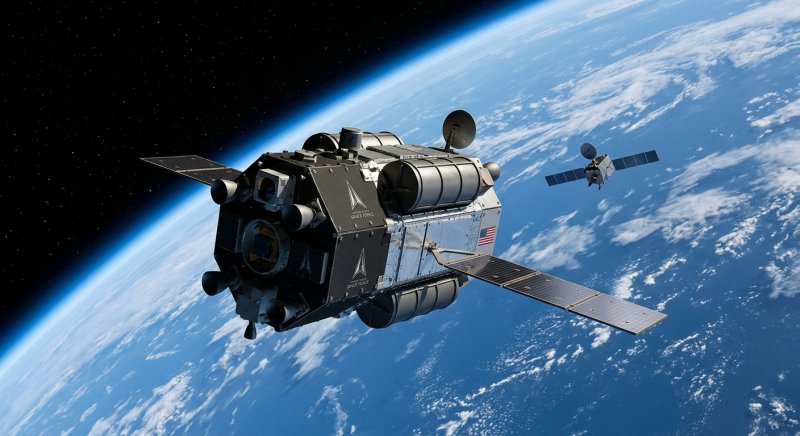
A senior US official has confirmed that America has put weapons in orbit, but he did not say what kind. Experts say the secrecy is only part of the problem: the rules for space are decades old, and nobody agrees on what counts as a “space weapon.”
What was actually said
US Air Force Secretary Troy Meink told a defense conference that the United States has deployed “space control weapons” in orbit to protect American forces from hostile action. He did not say what they are, how they work or whether they are aimed at other satellites. The US is not the only secretive country. A recent report by the Secure World Foundation, a nonprofit that promotes the peaceful use of space, found that 13 countries are developing such systems. They include satellites that can approach, inspect, disable or destroy other satellites, missiles fired from Earth to knock satellites out, jamming equipment, lasers that can blind satellite sensors, and hacking of space networks.
Why it is hard to know what a satellite is for
Anyone can see where a satellite is, but not necessarily what it can do. Countries must register their space launches with the United Nations, but they only have to give a general description, not the real purpose. This matters because much space technology is “dual use,” meaning it can serve both peaceful and military goals. China, for example, has a satellite with a robotic arm that has been used to tow a dead satellite out of orbit. The same arm could, in theory, grab an enemy satellite. As one expert put it, flying close to a satellite could mean refueling it, or attacking it.
An old treaty for a very different sky
The main rulebook is the Outer Space Treaty of 1967. It bans nuclear weapons and other mass-destruction weapons in orbit and says space should be used for peaceful purposes. It was written after the US and the Soviet Union exploded nuclear bombs in space, which knocked out satellites, phone lines and power grids on Earth. Back then, about 128 working satellites orbited the planet, all government-run. Today there are around 16,810, many owned by companies such as SpaceX.
The gap in the rules
The treaty says nothing clear about ordinary, non-nuclear weapons such as missiles or lasers. Experts call this a gap, and say the world never built the detailed rules needed on top of the treaty, for instance ways to check what countries are doing up there. Talks on a full weapons ban have stalled, partly because there is no agreed definition of a space weapon. Russia and China want a new treaty, while the US argues it overlooks missiles launched from the ground.
Space junk: the danger for everyone
Destroying a satellite creates thousands of fragments flying at extreme speed. When Russia destroyed an old satellite in 2021, it created over 1,500 pieces that endangered astronauts on the International Space Station and China’s space station. Experts fear a chain reaction in which collisions create debris, and debris causes more collisions. About 46,950 pieces are tracked today, and millions of smaller ones are estimated to exist. Because the US also depends on safe orbits, one expert suspects its new weapon may be non-destructive, such as a jammer.
This article is based on the Associated Press report “Some nations have deployed space weapons. Here’s what issues are worrying experts,” published on PBS.org on October 6, 2026.
Transparency Note: This article was prepared with the assistance of artificial intelligence technologies. Every piece is thoroughly reviewed and verified by our editorial team, who retain full responsibility for the final content.
Picture: Gemini AI