

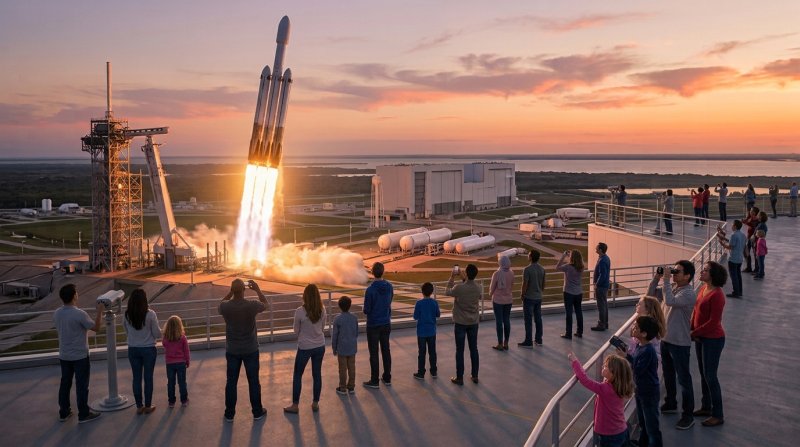
Reusable rockets, commercial launch firms and university teams are opening up orbit to far more players than ever. This year’s World Space Week asks who benefits, and who writes the rules.
From a few national programs to many players
For decades, launching anything beyond Earth was the privilege of a handful of national space agencies. That is changing fast. Reusable rockets, commercial providers, start-ups, student teams and newly space-faring countries are reshaping the sector. This shift gives the 2026 World Space Week its theme: Rocket revolution. The event, held every year from 4 to 10 October since 1999, brings together students, scientists, educators and space enthusiasts. More than 50,000 events are planned in over 100 countries.
Why wider access matters
Satellites already support communications, navigation, weather forecasting, disaster response and environmental monitoring. As launch costs fall, more countries can use space technology to pursue national priorities and grow their economies. The commercial space sector is heading toward a trillion-dollar global industry by 2030, and nations are eager to take part. According to Aarti Holla-Maini, head of the UN Office for Outer Space Affairs (UNOOSA), more countries and communities than ever can now use space for science, Earth observation and communications.
Access is more than a launch pad
Putting a rocket into orbit is only one part of the story. Real access also means having the knowledge, skills, infrastructure and opportunities to join the space sector and help shape its future. UNOOSA supports developing countries through programs such as Access to Space for All, the Global Space Law Project, Space4Women and Space4Youth. Over the past year, this included hands-on satellite training for aspiring engineers, astronaut training at NASA Space Camp for young people chosen through a competition, satellite deployment opportunities, and advisory missions helping countries draft their own space laws.
More activity, more responsibility
A crowded sky raises hard questions about governance. The UN Committee on the Peaceful Uses of Outer Space, set up in 1959, is the main global forum for these discussions. It deals with space traffic, debris, nuclear power sources in space, the use of space resources and the coordination of lunar activities. In 2025 it created an Expert Group on Space Situational Awareness to improve information-sharing as orbital traffic grows, and another team is looking at how countries can coordinate on and around the Moon. As Holla-Maini puts it, more actors in orbit make international cooperation more important, not less.
Joining in without leaving Earth
You do not need to be an astronaut to be part of the space community. World Space Week events around the world, listed on an interactive map, offer many ways for ordinary people to take part.
This article is based on a UN News report titled “Culture and Education,” published on 6 October 2026, about World Space Week and the work of UNOOSA.
https://news.un.org/en/story/2026/10/1168538
Transparency Note: This article was prepared with the assistance of artificial intelligence technologies. Every piece is thoroughly reviewed and verified by our editorial team, who retain full responsibility for the final content.
Picture: Gemini AI