

A medium-lift launch vehicle whose upper stage becomes a one-megawatt computing platform in orbit
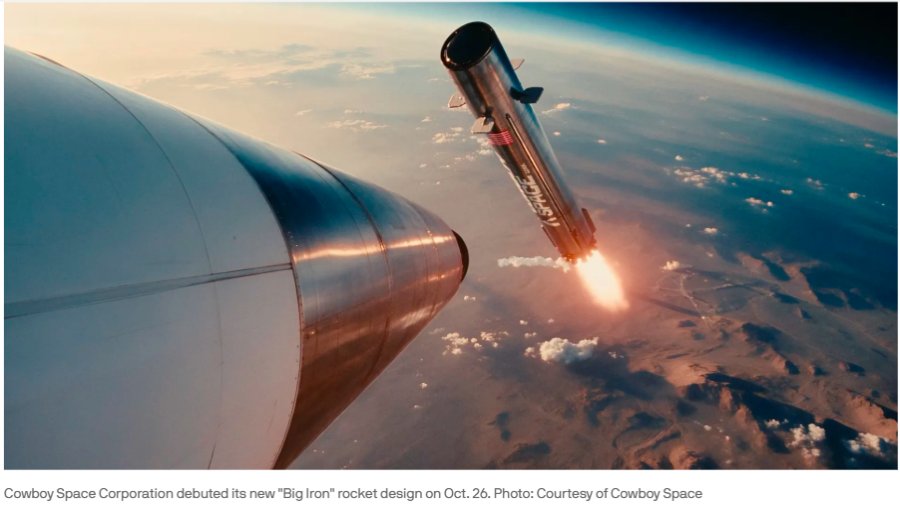
Most rockets deliver a payload and discard their upper stage as debris. Cowboy Space Corporation wants to turn that stage into the payload itself. The company has unveiled the design of “Big Iron,” a medium-lift rocket whose upper stage is meant to serve as an orbital data center satellite.
One vehicle, two jobs
According to Axios, Big Iron is named after the Marty Robbins country classic. The company’s chief operating officer, Joseph Yaffe, said the first rocket is planned for completion by the end of 2027, with a first flight targeted for 2028. In conventional launch design, the upper stage and the payload are separate objects, each carrying its own structure and systems. Cowboy Space says it integrates the two into a single vehicle, which reduces redundant mass and optimises the power and compute delivered to orbit. Every kilogram saved on structure is a kilogram available for useful hardware.
From energy startup to orbital infrastructure
The company was founded in 2024 as Aetherflux, initially focused on capturing solar energy in space. In May 2026 it announced a $275 million Series B round at a $2 billion valuation and adopted the Cowboy Space name, reflecting a broader goal of connecting launch vehicles, space-based power and in-orbit computing. Index Ventures led the round, joined by investors including IVP, Blossom Capital and SAIC. The company also announced a collaboration with NVIDIA to deploy Space-1 Vera Rubin Modules in low Earth orbit.
Why put computing in space?
The physics behind the idea is straightforward, even if the engineering is not. In suitable orbits, solar panels can collect sunlight with far fewer interruptions than on the ground, with no atmosphere or weather in the way. Each Big Iron upper stage is intended to become a one-megawatt data center once in orbit. Yaffe also said the payload section can be swapped for a satellite dispenser, which widens the market beyond computing. These satellites would feed the planned 20,000-satellite “Stampede” constellation.
The hard parts
Space is not a free cooling system. In vacuum, waste heat cannot be carried away by air and must be shed through radiators, so a megawatt-class computer demands large radiating surfaces and careful thermal design. Radiation also degrades electronics over time, and repair visits are impractical. Whether the economics can beat terrestrial data centres remains to be demonstrated, and the schedule leaves little room for delay.
A market gap with strategic weight
The timing may help. Axios reports that SpaceX is said to be planning to retire its Falcon 9, which would leave a gap in medium-lift launch capacity and create difficulties for national security missions. Cowboy Space bets that owning its launch vehicle and reusing its components will lower costs, while opening access for military and commercial customers.
What to watch
The next milestones are the first completed rocket and the 2028 debut flight. Until then, Big Iron is a design and a wager that the future of computing may be built, and launched, in a single piece.
Sources: Axios: Cowboy Space unveils “Big Iron” rocket | Cowboy Space: Introducing Cowboy Space, a $275 Million Series B
Transparency Note: This article was prepared with the assistance of artificial intelligence technologies. Every piece is thoroughly reviewed and verified by our editorial team, who retain full responsibility for the final content.