

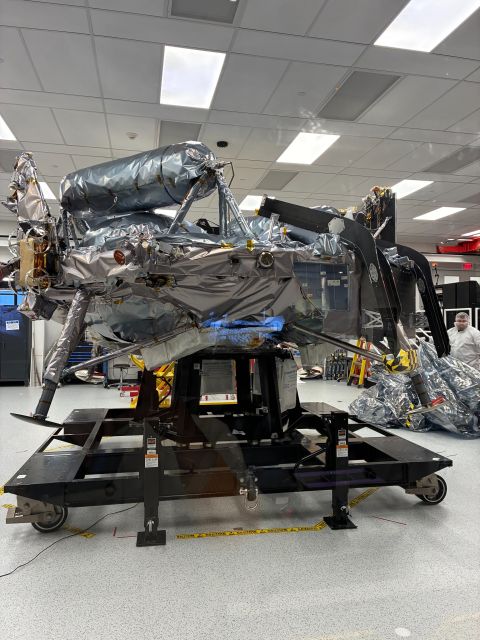
Astrobotic’s large lunar lander completes its environmental test campaign and moves to Pittsburgh’s Moonshot Museum
The journey to the Moon starts long before liftoff. Before Griffin-1 can touch the lunar surface, it has to prove it can survive the violence of launch and the extremes of space, and according to Voyager Technologies, it has now done so. With its planned system-level acceptance testing complete, the lander has moved to the Moonshot Museum in Pittsburgh, where it awaits the next stage of its journey.
A heavyweight in the commercial lunar fleet
Griffin-1 is a large commercial lunar lander developed by Astrobotic, with Voyager Technologies involved in the programme. It is designed to deliver substantial payloads to the lunar surface, including NASA instruments carried under the agency’s commercial lunar services model. In this approach, space agencies buy transport as a service from private companies instead of owning and operating the vehicle themselves, a concept that has become a pillar of modern lunar exploration.
Four tests, four different threats
Each evaluation in the campaign targets a distinct failure mode, which is why engineers run them all.
- Acoustic testing blasts the spacecraft with intense sound, simulating the roaring noise field inside a rocket fairing at liftoff.
- Vibration testing reproduces the mechanical loads of launch, which can loosen fasteners or fatigue brackets and electronics.
- Electromagnetic compatibility evaluations confirm that onboard systems can operate together without interfering with one another.
- Thermal vacuum testing validates performance in a chamber built to replicate the extreme conditions of space.
Engineers often call this gauntlet “shake and bake”, and a lander that passes it has demonstrated real margin against what lies ahead.
Why the vacuum chamber matters
In a vacuum there is no air to carry heat away by convection, so a spacecraft exchanges heat only through conduction and radiation. A sunlit surface can become extremely hot while a shadowed one plunges to cryogenic temperatures. Insulation, heaters and radiators must keep every component within its operating range through these swings. Verifying that design in a chamber, with sensors monitored in detail, is far cheaper than discovering a flaw in lunar orbit, where no repair is possible.
Finding resonances before they find you
Launch is one of the most violent phases of any mission. Structures that look robust on paper can resonate unexpectedly under acoustic and vibrational loads, and such effects are hard to predict from models alone. Discovering them on the ground allows designers to adjust the hardware before it ever leaves the pad.
More than a milestone
These results reflect months of engineering, collaboration and problem solving by the teams preparing Griffin-1. The move to the Moonshot Museum also gives the public a rare look at flight hardware before it departs, which matters in an industry that depends on sustained public and political support.
What comes next
Passing environmental testing does not guarantee a successful landing, and touching down on the Moon remains one of the hardest feats in spaceflight. Still, clearing this gate removes a major category of risk and brings Griffin-1 one step closer to its destination.
Source: Voyager Technologies LinkedIn post
Transparency Note: This article was prepared with the assistance of artificial intelligence technologies. Every piece is thoroughly reviewed and verified by our editorial team, who retain full responsibility for the final content.