

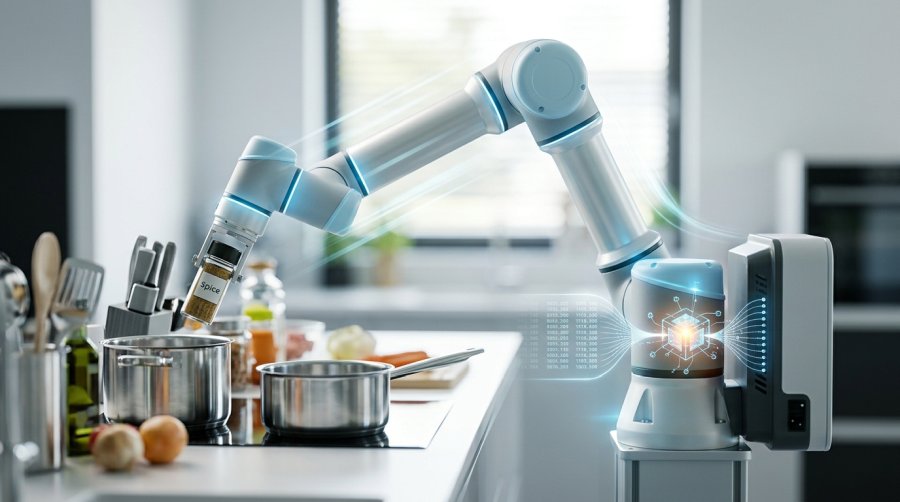
For a robot to perform multi-step tasks—like cooking a meal or searching for misplaced items—it needs to remember past events. But managing robotic memory presents a frustrating tradeoff: storing a full visual history overwhelms the robot with irrelevant details, while using large Vision-Language Models (VLMs) to filter that history in real time makes the robot’s reactions painfully slow.
A new framework introduces a workaround by shifting the heavy computational lifting entirely to the training phase. During training, a large VLM analyzes the environment and pinpoints which past and present details are actually essential to complete the task. The system then distills this crucial information into a compact memory representation called a workspace token.
When deployed in the real world, the robot relies solely on this lightweight token, completely removing the need to query slow AI models on the fly.
How Can a Small Token Handle Complex Tasks?
It might seem counterintuitive that a tiny data package can hold enough information for complex, multi-step jobs. The efficiency comes down to three factors:
- Fixed Mathematical Size: The workspace token is not a growing video file or an expanding event log. It is a fixed-length numerical vector (a small array of numbers). Its size stays strictly the same whether the task takes thirty seconds or ten minutes.
- Stripping Away Visual Fluff: Camera feeds are filled with redundant data—wall textures, lighting shifts, and background objects. The model discards 99% of raw pixels, isolating only the variables that directly impact the goal.
- Abstract Facts over Raw Data: Traditional robot memory is like saving a 10-minute 4K video of a room to remember where an item was placed. The workspace token operates like a single text note reading: “The key is in drawer #2.” Because the logical state of a complex task usually boils down to a few core facts, it easily fits inside a compact mathematical footprint.
Faster Reactions, Better Results
Experiments conducted in both simulation and on real robot hardware demonstrated that replacing live VLM queries with workspace tokens did more than just cut computation costs. Removing visual clutter and concentrating strictly on task-relevant facts actually improved overall task success rates. By streamlining how information is stored and processed, robots can execute memory-intensive operations faster, cheaper, and more reliably.
Transparency Note: This article was prepared with the assistance of artificial intelligence technologies. Every piece is thoroughly reviewed and verified by our editorial team, who retain full responsibility for the final content.
Picture: Gemini AI
Original abstract:
complex robotic manipulation tasks frequently require a long-term memory of past events and actions. As conditioning on full histories renders policies prone to spurious correlations and degrades performance, many approaches to policy memory involve compressing historical information through expensive VLM queries in-the-loop to process only task-salient information. In this paper, we propose an alternative approach in which computationally intensive VLM queries are made during train-time to learn a lightweight latent memory that can be efficiently queried at deployment time. Our representation, which we call the \textbf{workspace token}, is trained by (1) using a VLM to identify current and historical information necessary for completing a task, then (2) distilling these into the workspace token using a set-reconstruction decoder loss. In both simulation and hardware, we show that the workspace token can be used as a drop-in replacement for observations during deployment, enabling policies to solve memory-intensive tasks without the need for VLM reasoning in-the-loop. Interestingly, we found that workspace tokens are not only more lightweight but also lead to better policy performance.
Source: arXiv