

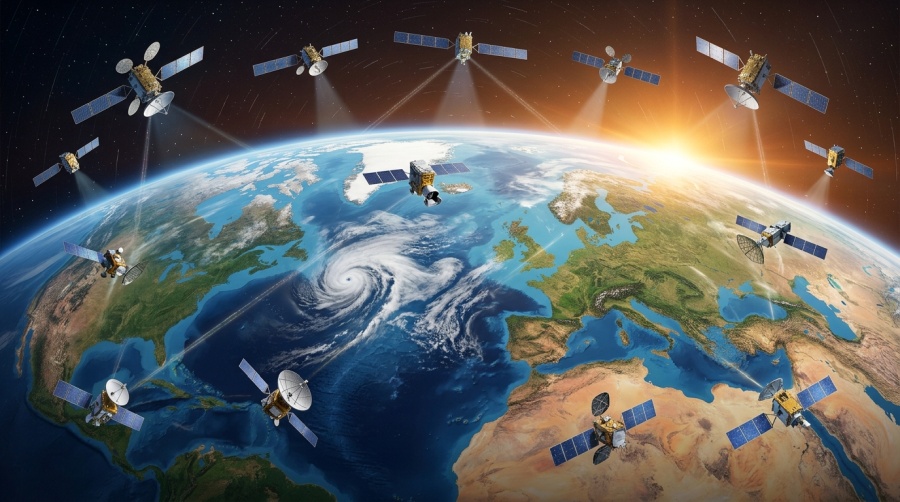
Satellites currently do two main jobs. Some handle communications — beaming internet, phone signals, and TV around the globe. Others handle sensing — watching Earth’s weather, oceans, and land from orbit using radar. Currently more than 8,000 satellites are dedicated to communications and data services, and more than 1,000 are dedicated to sensing applications.
Original source: arxiv
Traditionally these have been built as completely separate systems, each with its own antennas, radios, and onboard electronics — even though they’re often doing conceptually similar things (sending and receiving radio signals). A team of researchers, including Chandan Kumar Sheemar and Jorge Querol at the University of Luxembourg, argues this separation is becoming wasteful as demand for both data and sensing keeps growing.
The idea: one system, two jobs
Their proposed fix is called Joint Communications and Sensing (JCAS) — sometimes also called Integrated Sensing and Communication (ISAC) elsewhere in the field. The idea is to let a single satellite payload do both communication and sensing at the same time, using the same hardware and the same slice of radio spectrum, instead of building two separate systems.
Combining these functions can boost spectral efficiency by using joint waveforms and shared frequency bands, letting a satellite transmit data and sense its surroundings without needing separate frequency allocations. This also shrinks the payload — fewer duplicated antennas, radios, and processors — which cuts satellite mass and launch costs, and can extend how long a satellite stays useful in orbit.
Why this is hard to do in space
Combining the two functions is far harder in orbit than on the ground. Satellites travel at very high speeds relative to ground users and targets, causing large frequency shifts (the Doppler effect) that can throw off synchronization and increase errors if left uncorrected. On top of that, satellites cover huge distances, so signals weaken a lot before they arrive, and a single satellite beam can sweep across wildly different terrain — ocean, ice, cities — all of which reflect signals differently and complicate sensing.
To address this, the researchers point to several engineering directions, including:
- Radio waveforms (like adaptable versions of OFDM, or radar-style “chirp” signals) that can tolerate the Doppler shift and still support both jobs at once
- Smarter beamforming that predicts where a satellite, user, or target will be next, rather than just reacting
- Turning the Doppler shift from a nuisance into useful information, since it also reveals how fast a target is moving
Testing the idea with a simulation
Rather than leaving this purely theoretical, the team ran a computer simulation to test whether the concept actually works. They modeled a satellite at 4.2 GHz, roughly 500 km from a ground-based communications user and about 490 km from an aircraft target, with a nearby ground receiver picking up the radar reflections bounced off that aircraft. The results showed that as they increased the number of transmit antennas and the transmit power, both communication speed and radar-sensing accuracy improved together — evidence that a single shared system really can support both jobs reasonably well, at least in this simulated scenario. (They also tested a different radar setup — one where the receiver and transmitter are the same satellite instead of separate points — but found the signal loss over that path was too extreme to make it practical.)
What’s still unsolved
The paper closes by flagging open problems still standing in the way of real-world use: designing waveforms and beamforming strategies robust enough for orbital speeds, managing the Doppler effect well enough that it helps rather than hurts, and — perhaps trickiest of all — figuring out the regulatory and privacy rules for a technology that blurs the current legal line between “communications” and “radar,” especially given that high-resolution sensing from orbit could reveal sensitive information about people or places without any realistic way to get their consent.
*
Original abstract: satellite networks (SN) have long provided two fundamental services: global communications and Earth-oriented sensing, supporting applications from connectivity and navigation to disaster management and environmental monitoring. Yet, the accelerating demand for data and the emergence of new applications render the independent evolution of communication and sensing payloads increasingly unsustainable. Joint communications and sensing (JCAS) has emerged as a transformative paradigm, integrating both functions within a unified payload to enhance spectral efficiency, reduce operational costs, and minimize hardware redundancy. Beyond efficiency, this integration creates opportunities for novel services that are infeasible under separate payload designs. This paper motivates the role of JCAS in shaping the sixth-generation (6G) of satellite networks, explores a representative use case to assess its feasibility, and discusses key challenges that must be addressed to unlock its full potential. By highlighting these opportunities inherent to the space environment, we aim to stimulate the development of JCAS as a cornerstone technology for the next-generation space era.
Transparency Note: This article was prepared with the assistance of artificial intelligence technologies. Every piece is thoroughly reviewed and verified by our editorial team, who retain full responsibility for the final content.
Picture: Gemini AI